 CoinYearValue
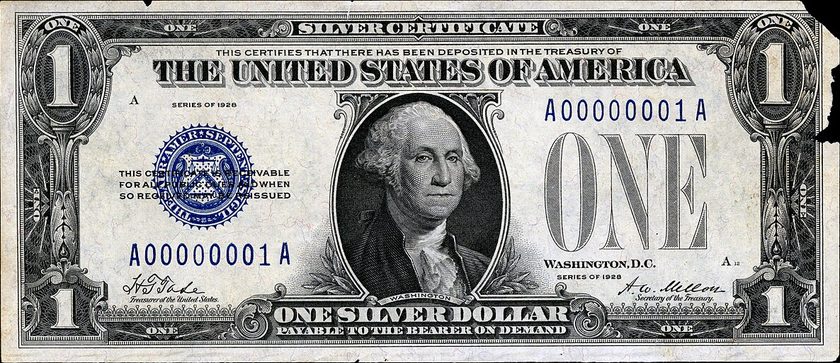
The first small $1 bill, and why its last three letters are hard
These were the first small-size silver certificates, released to the public in 1929 and signed by Tate as Treasurer and Mellon as Treasury Secretary. Their promise was literal. The Treasury had to keep actual silver dollars on deposit to back every note that said ONE SILVER DOLLAR, and that wording only lasted through 1928E before it was loosened to dollars in silver.
Most of the notes you will run into are 1928, 1928A or 1928B, all printed in large numbers. The picture changes after that. The 1928C, signed by W.O. Woods and William Woodin, had a printing of 5,364,348; Woods and Woodin held office together only from March to the end of May 1933. The 1928D, with Julian and Woodin, is the easiest of the late three at nearly 14.5 million. The 1928E, the only one with Henry Morgenthau's signature, is the lowest at 3,519,324.
The A and B letters also hide a paper test. The BEP printed three batches with special serial blocks: X-B and Y-B notes went on two different experimental papers, and Z-B notes on regular paper as a control. The ranges run from X00000001B to X10728000B, and to Y10248000B and Z10248000B for the other two.
Replacement notes from the late letters barely exist. About 12 examples of the 1928C star are known, and roughly two dozen of the 1928D star.
What to check on this one
- Read the signatures at the bottom: Woods and Woodin is a 1928C, Julian and Woodin a 1928D, Julian and Morgenthau a 1928E. Those three are the scarce letters.
- A serial that starts with X, Y or Z and ends in B is one of the experimental paper notes from 1928A or 1928B.
- The obligation should read ONE SILVER DOLLAR. If it says ONE DOLLAR IN SILVER, you have a 1934 or later note.
- Any 1928C or 1928D star is worth sending to PMG or PCGS Banknote. Only about three dozen are known across the two letters.
Sources: Silver Certificates carried blue seal (Numismatic News); Small Size Silver Certificates And Experimental Notes (PMG); Silver certificate (United States); A Numismatic Oddity: The Series of 1928 $1 Legal Tender Note (Stack's Bowers); Collecting $1 Silver Certificates (Numismatic News).