 CoinYearValue
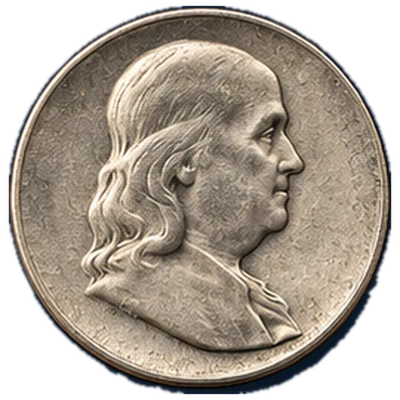
Nellie Tayloe Ross's Franklin half and its short run
Benjamin Franklin got a coin because the head of the Mint wanted him on one. Director Nellie Tayloe Ross asked Chief Engraver John R. Sinnock after World War II to rework the Franklin medal he had made in 1933 into a half dollar. Sinnock had designed the Roosevelt dime only a short time before. Sinnock died in May 1947 while the preliminary work was still underway, and Gilroy Roberts finished the engraving. Roberts would later cut the Kennedy portrait that replaced Franklin. The coin was released on April 30, 1948, with JRS spelled out under the bust.
The Liberty Bell on the reverse came from Sinnock's 1926 Sesquicentennial half dollar, and numismatists now credit that bell to a sketch by John Frederick Lewis. The small eagle beside it was added late because federal coinage law required an eagle on every denomination larger than the dime. The Commission of Fine Arts disliked the design and worried the bell's crack would invite jokes about the coin; collector Rick Tomaska later argued a bell without its crack would have drawn even more puns. Its opinion was only advisory, and Treasury Secretary John W. Snyder approved the design anyway.
Circulation mintages ran from a low of 2,498,181 in 1955 to a high of 67,069,292 at Denver in 1963. Proofs were added to the annual sets starting in 1950, with 51,386 that year and a peak of 3,218,019 in 1962. CoinWeek says the series has no date rarities, and PCGS names the 1949-D and 1950-D as tougher dates. The real difficulty is strike. The horizontal lines across the bottom of the bell often came out incomplete, and coins with them intact are labeled Full Bell Lines. Only 69 1953-S halves had been certified with Full Bell Lines against 10,440 for the 1953-D, which makes the 1953-S the conditional key. CoinWeek points to the 1954-D as one of the easier dates to find with full lines.
Two varieties get attention. A die clash on many 1955 and 1956 coins left a spike at Franklin's lip from the eagle's wing, and collectors call it the Bugs Bunny. The 1961 proof doubled die reverse is the costly one, and the 1949-S also exists with a repunched mint mark. Cameo and Deep Cameo proofs, with frosted portraits on mirror fields, are collected as a separate tier.
The design was cut short. After President Kennedy was killed in November 1963, Congress quickly moved to put him on the half dollar starting in 1964. Under the 25-year rule, Franklin could otherwise have stayed in production at least another decade. Each coin holds 0.36169 troy ounce of silver, and CoinWeek estimates at least a million uncirculated Franklins sit uncertified in collections.
What to check on this one
- Look at the lines across the bottom of the Liberty Bell. PCGS calls a coin Full Bell Lines only when they are fully separated and the coin is MS60 or better.
- On 1955 and 1956 halves, check Franklin's mouth for a small spike pointing out from his lip; that is the Bugs Bunny clash.
- A 1949-S with a second S visible under the mint mark above the bell's beam is the repunched mint mark variety.
- On proofs from 1950 to 1963, compare the portrait to the field; strong frost on the portrait against mirror fields is what cameo grades mean.
Sources: The Franklin Half Dollar Turns 75 (PCGS); Franklin Half Dollar, 1948-1963: A Collector's Guide (CoinWeek); What's the 'JS' on the Roosevelt Dime Mean? (PCGS); Walking Liberty Half Dollar, 1916-1947 (CoinWeek).