 CoinYearValue
Weinman's walking Liberty and the strike problem nobody fixed
Charles Barber's half dollar passed the 25-year mark set by the Mint Act of 1890, and in 1916 Mint Director Robert W. Woolley looked to outside sculptors for its replacement. Adolph A. Weinman, a former student of Augustus Saint-Gaudens, won, the same year his winged Liberty dime and Hermon MacNeil's Standing Liberty quarter appeared, so all three of Barber's silver designs gave way within a single year. CoinWeek traces part of the coin's lasting appeal to motifs Weinman borrowed from French art of the period and adapted to American subjects.
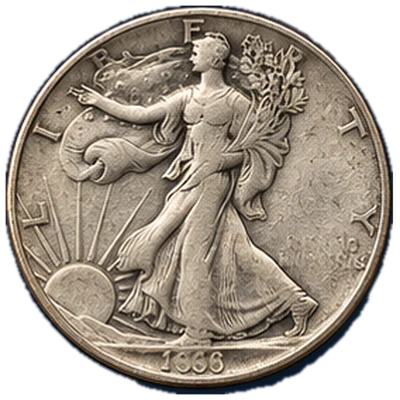
Liberty strides toward the left with her right arm reaching out and a bundle of oak and laurel branches in her left hand. A flag billows behind her, and a low sun throws rays from behind a mountain. On the back, a bald eagle stands on a rocky outcrop gripping a pine branch with needles and cones. Early pieces from 1916 and part of 1917 carry the D or S on the obverse under IN GOD WE TRUST, before the mark moved to the lower left of the reverse, so 1917 Denver and San Francisco halves come in two collectible positions.
The design's weak spot is mechanical. Its highest points on each side sit directly opposite each other, so metal could not fill both at once, and Liberty's left hand and leg often came out flat along with the eagle's breast and leg feathers. George Morgan's adjustments in 1918 and 1921 and John Sinnock's in the late 1930s did not solve it. Many mint-state coins, especially 1920s dates and branch-mint coins from the 1930s and 1940s, look lightly worn when they are not, so a flat hand on its own says little about wear.
Production stopped and started with demand. No halves were made in 1922, from 1924 through 1926, or from 1930 through 1932. The 1921 issues are the keys. Denver's 208,000 were the fewest of any circulation-strike Walking Liberty, and Philadelphia also stayed under a quarter million. Even so, the 1921-S is the most valuable in mint state; CoinWeek says the other two are each roughly twice as common new. The 1919-D, at 1,165,000, is another date that is very scarce new. At the other end, wartime demand pushed 1943 production to 53,190,000, the most of any year, which is why 1940s dates are the ones that turn up most. PCGS includes the 1921-D among its top 50 U.S. coins of all time.
Whitman's boards in the 1950s and 1960s made two sets popular: the full 1916 to 1947 run and a short set of 1941 to 1947 dates. Sinnock's Franklin half replaced the design after 1947, and the U.S. Mint marks that year as the last time Liberty appeared on a circulating U.S. coin.
What to check on this one
- On 1916 and 1917 halves, check both the obverse below IN GOD WE TRUST and the lower left reverse for the mint mark; its position separates two different 1917-D and 1917-S coins.
- Judge wear on the eagle's breast and on Liberty's head rather than her left hand, since the hand was often struck flat even on new coins.
- Look for a D or S at the lower left of the reverse on any 1921 half; all three 1921 mints are scarce, and the Denver coin has the lowest mintage of the series.
- The years 1922, 1924 to 1926 and 1930 to 1932 have no regular halves, so a coin dated in one of those years is not genuine.
Sources: Walking Liberty Half Dollar, 1916-1947 (CoinWeek); Building the Ultimate 20th-Century Type Set, Part 4: Barber and Walking Liberty Half Dollars (CoinWeek); The Top 50 U.S. Coins of All Time (PCGS); History of U.S. Circulating Coins (U.S. Mint); Mercury Dime, 1916-1945: History and Value (CoinWeek).