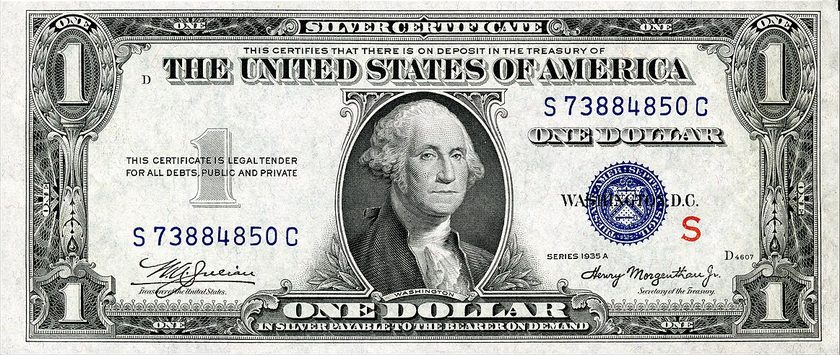
A Series 1935A silver certificate with the red S of the 1944 paper experiment. Regular 1935 notes have no red letter. Image: Wikimedia Commons, public domain.
A worn 1935 $1 silver certificate is worth about $5 to $16. Uncirculated ones sell for about $16 to $28.
Wartime Hawaii and North Africa notes, and the experimental R and S notes, are worth much more.
Check the seal color and look for a red R or S. Those versions are worth far more.
Worn$5–16Folds, soft paper, normal wear
Uncirculated$16–28Crisp, no folds, never spent
Star note$10–25Star (★) in the serial number
1935: one date on the dollar for almost 30 years
The 1935 date marked a new design, not a print year. The back now showed both sides of the Great Seal, a change President Roosevelt helped push. After that, each new signer only added a letter, and the date ran all the way to 1935H. Some of these notes were still being released in 1963.
The letters track the Treasury officials. Julian and Morgenthau signed 1935 and 1935A; Julian and Vinson the B; Julian and Snyder the C; Clark and Snyder the D; Priest and Humphrey the E; Priest and Anderson the F; Smith and Dillon the G. The 1935G exists both with and without the motto on its back, because the motto was added partway through that series.
World War II produced the special issues. After Pearl Harbor, 1935A notes with brown seals and HAWAII overprints were issued from July 1942 to October 1944, and yellow seal notes went to troops in North Africa in 1942. In June 1944 the BEP released a paper test: 1,184,000 notes with a red R for regular paper and 1,184,000 with a red S for special paper, plus 12,000 stars of each. Together they were under 1% of all 1935A notes, and the test never gave a clear answer.
Plain 1935 notes had their own experiment, run in three serial blocks for a special finish, a special paper and a regular control. Mules also appear in this series. At the FBI's request the tiny plate check numbers grew from 1/2 millimeter to a full millimeter, and old back plates stayed in use alongside the new faces.
What to check on this one
A genuine R note has a serial between S70884001C and S72068000C; a genuine S note falls between S73884001C and S75068000C. A red letter on any other serial was added later.
Turn over a 1935G. With the motto and without it are two different varieties.
A plain 1935 with a serial in the A00000001B to A06180000B, B00000001B to B03300000B or C00000001B to C03300000B range is one of the experimental batches.
A real Hawaii note has HAWAII printed on both sides as well as the brown seal. A brown seal alone is not enough.
Blue seal, blue serial numbers and SILVER CERTIFICATE across the top. The series date runs from SERIES 1935 to 1935 H.
The back shows the Great Seal of the United States, like a modern $1 bill.
Brown seal with HAWAII printed on it: a World War II Hawaii note. Yellow seal: a North Africa note.
Versions worth more
1935A Hawaii
$40–72 worn, $80–150 uncirculated
Brown seal and HAWAII overprints, issued in Hawaii during World War II.
1935A North Africa
$53–86 worn, $175–200 uncirculated
Yellow seal, issued to troops in North Africa and Europe.
1935A red R or S
$100–190 worn; $480–730 in PMG 63–65
A large red R or S on the face marks a 1944 test of two paper types.
Star note
$10–18 worn, $18–25 uncirculated
A star (★) before the serial number.
Check your serial number
Type the 8 digits of the serial number. Add the letters and the star if your note has them; the checker reads the digits.
Questions
Is a 1935 silver certificate rare?
Regular blue seal notes are common. The Hawaii, North Africa and red R or S notes are the scarce ones.
Can I trade a silver certificate for silver?
No. That ended on June 24, 1968.
Is old paper money still legal tender?
Yes. All U.S. paper money issued since 1861 is still legal tender at face value. Collectors usually pay more for older or crisp notes.
Where can I sell it?
For common notes, a local coin or currency dealer is quickest. eBay works for notes worth $20 or more. Send notes worth several hundred dollars to a currency auction house.
Should I get it graded?
Only if it's worth well over $100. Grading by PMG or PCGS Banknote costs tens of dollars per note plus shipping, which is more than most common notes are worth.
Protect your notes: currency sleeves keep bills flat and clean, and a 10x loupe helps you read seals and serial numbers.
As an Amazon Associate I earn from qualifying purchases. As an eBay Partner Network affiliate, we may also earn a commission when you buy through links on this site, at no extra cost to you.
Values checked October 9, 2026 against recent sold listings. They are typical prices, not offers. Worn modern notes are valued at face, since that is what a bank or store gives you. How values work.
 CoinYearValue