 CoinYearValue
Home / Washington quarters / 2004 quarter
2004 Wisconsin Extra Leaf Quarter Value
- Worn$50–90Circulated, as found
- Uncirculated$92–125No wear, MS60 to MS63
- Certified MS65$145–220Graded by PCGS or NGC
Lower figures are for the Low Leaf, higher ones for the High Leaf. Both are in the table below.
A regular Wisconsin quarter is worth 25 cents. A 2004-D Wisconsin quarter with an extra leaf on the corn is worth about $50 to $90 worn, $92 to $125 uncirculated and $145 to $220 in certified MS65. There are two versions, Extra Leaf High and Extra Leaf Low.
Only Denver coins have the extra leaf. A Denver press operator told investigators that 35,000 to 50,000 "leaf up" quarters may have been struck and shipped, against earlier guesses of about 1,000. The investigation did not cover the Low Leaf.
Check every 2004-D Wisconsin quarter you find: the extra leaf is visible with a simple magnifier.
How to spot an Extra Leaf quarter
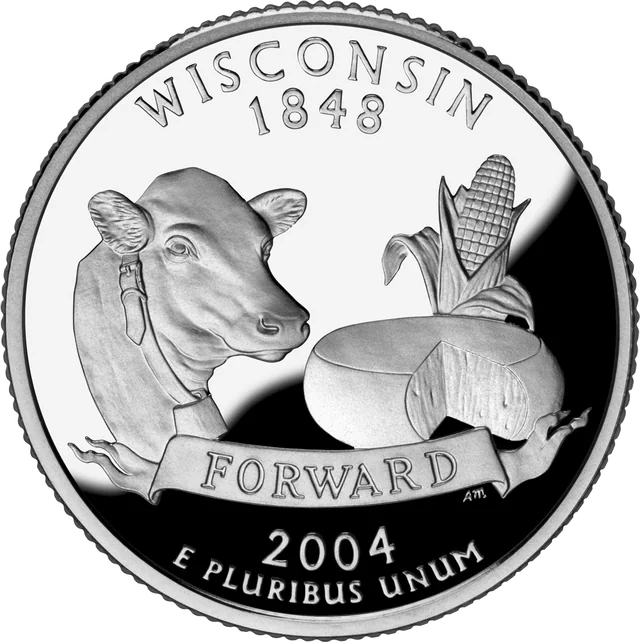
Turn the coin over and find the ear of corn behind the wheel of cheese. The extra leaf, when there is one, is on the left side of the ear.
United States Mint image (Wikimedia Commons).

- Check for a D mint mark. It is on the front, to the right of Washington's ponytail. Every Extra Leaf quarter is a 2004-D; Philadelphia coins and San Francisco proofs never have it. (CoinValueChecker)
- Find the ear of corn on the back. The design shows a cow's head, a wheel of cheese and an ear of corn above the banner FORWARD. Look at the husk leaves on the left side of the ear for one that is not part of the design. (Wikipedia; Numismatic News)
- Extra Leaf High. The extra leaf turns up, sitting higher and closer to the ear, alongside the normal husk leaves. (Reeded Edge; CoinValueChecker)
- Extra Leaf Low. The extra leaf sits lower, coming out from the ear and curving down toward the cheese. PCGS described it in January 2005 as particularly large and shaped like a leaf. (Reeded Edge; Wikipedia; The E-Sylum)
- Tilt the coin under a light. A real extra leaf is raised, with the same luster as the rest of the design. A sunken line or scratch is damage, not the variety. (The E-Sylum; CoinValueChecker)
- Read the holder. Graded coins are labeled Extra Leaf High (FS-5901) or Extra Leaf Low (FS-5902). (Heritage Auctions; CoinValueChecker)
What a 2004 Wisconsin Extra Leaf quarter is worth
| Grade | Extra Leaf High | Extra Leaf Low |
|---|---|---|
| UncirculatedUnc. MS60No wear, but plenty of marks | $100 | $92 |
| Choice UncirculatedChoice Unc. MS63No wear and only a few marks | $125 | $115 |
| Gem UncirculatedGem Unc. MS65Certified and nearly flawless | $220 | $145 |
MS60 and MS63 are uncirculated coins; MS65 is a coin certified by PCGS or NGC. Values are the middle of the price guides that list this variety (CoinValueChecker, PriceCharting), checked November 16, 2026. How values work.
Worn coins. Most Extra Leaf quarters were found in circulation. CoinValueChecker's guide runs from $50 to $59 in Extremely Fine to $87 to $100 in AU58, and coins certified AU55 and AU58 brought $76 and $81 in 2023. Ungraded coins on eBay, many of them uncirculated, sold for mostly $100 to $170 (High Leaf) and $60 to $115 (Low Leaf) in 2026. (CoinValueChecker; PriceCharting, High; Low)
Recent auction results listed by CoinValueChecker: in MS65, High Leaf coins sold for $168 to $225 and Low Leaf coins for $144 to $192 (2023); in MS66, High Leaf coins brought $241 to $288 and Low Leaf coins $192 to $255 (2023 to 2025). A Low Leaf graded MS67 sold for $1,100 in March 2023. (CoinValueChecker)
Easy mix-ups
- Regular Wisconsin quarters. Coins without the extra raised leaf are worth face value in circulated condition, whatever the mint mark. (CoinValueChecker)
- Scratches and gouges. Damage near the corn is sunken and rough. The genuine leaf is raised and matches the coin's surface. (CoinValueChecker)
- High and Low mixed up. Up-curving and close to the ear is High; lower down and curving toward the cheese is Low. Listings get this wrong: PriceCharting's High Leaf page includes a sale titled Extra Leaf Low. (Reeded Edge; PriceCharting)
- A die clash. The Treasury Inspector General's investigation ruled out clashed dies as the cause. (Numismatic News)
How the extra leaf happened
Bob Ford of Tucson, Arizona, a roll searcher for 15 years, spotted the extra leaves on December 11, 2004, while going through 2004-D Wisconsin quarters, and took them to Rob Weiss of Old Pueblo Coin Exchange. "One variety has an extra leaf that goes up," Weiss told the Arizona Daily Star; the other curves down. Most were found around Tucson and near San Antonio, Texas. (Reeded Edge; The E-Sylum; Numismatic News)
The find caused a stir. PCGS founder David Hall called them the first major variety of the state quarter series. A set of all three Wisconsin quarters, regular, High and Low, sold on eBay for $300 in February 2005, and single coins soon reached $1,500. That spring, Tucson collectors and dealers knew of about 2,000 High Leaf and 2,700 Low Leaf coins. (Reeded Edge; Wikipedia)
The Treasury's Office of Inspector General investigated, and USA Today reported its findings in January 2006. On a Friday night in November 2004, a Denver press operator found "leaf up" quarters, stopped the press and went on a meal break. The press was restarted, and about an hour and a half passed before it was stopped again and the die changed. The operator estimated that 35,000 to 50,000 of them were made and shipped with good coins. (Numismatic News; The E-Sylum)
The report found no intentional act and blamed some part of the process outside human control. No one was fired or charged, and the report did not explain the Low Leaf. From January 2005 the Denver Mint began keeping a sample of the last coins struck by each die. (The E-Sylum; Numismatic News)
Questions
How do I know if my Wisconsin quarter has the extra leaf?
Check for a D mint mark on the front, then look at the left side of the ear of corn on the back. An extra raised leaf curving up beside the ear is the High Leaf; a leaf lower down, curving toward the cheese, is the Low Leaf.
How much is a 2004-D Wisconsin Extra Leaf quarter worth?
About $50 to $90 worn. Uncirculated, about $100 for the High Leaf and $92 for the Low Leaf in MS60, and $220 and $145 in certified MS65. The highest price we found is $6,000 for a PCGS MS67 Low Leaf sold by Heritage in January 2020.
Which is worth more, High Leaf or Low Leaf?
In most grades the High Leaf: $220 against $145 in certified MS65. The single highest sale, though, is a Low Leaf in MS67.
Are there Philadelphia Extra Leaf quarters?
No. All Extra Leaf quarters were struck at Denver.
How many Extra Leaf quarters were made?
Nobody knows exactly. The press operator who found the "leaf up" coins estimated 35,000 to 50,000; earlier estimates were about 1,000. The investigation did not cover the Low Leaf; in spring 2005, Tucson collectors knew of about 2,700.
How did the extra leaf get there?
The cause is still unknown. The Treasury Inspector General found no intentional act and blamed some part of the production process outside human control; the report did not explain the Low Leaf.
Sources
- CoinValueChecker: 2004 quarter value
- CoinValueChecker: 2004 quarter errors
- CoinValueChecker: state quarter errors list
- PriceCharting: 2004-D Extra Leaf High
- PriceCharting: 2004-D Extra Leaf Low
- Numismatic News: Mint explains Wisconsin quarter error
- The E-Sylum: Wisconsin quarter variety story (2005)
- The E-Sylum: Wisconsin quarter variety explained (2006)
- Reeded Edge: New leaves turning up and down on Wisconsin quarters
- Wikipedia: 2004 Wisconsin quarter misprint
- Heritage Auctions: 2004-D Wisconsin Extra Leaf Low, FS-5902, MS65 PCGS
Check real sales
Recent sold listings show what coins like yours actually bring: see sold 2004-D Wisconsin Extra Leaf quarters on eBay. Check the photos: many listings use the variety's name for ordinary coins.
To check your own coins: a 10x loupe and coin holders to keep a find safe.
As an Amazon Associate I earn from qualifying purchases. As an eBay Partner Network affiliate, we may also earn a commission when you buy through links on this site, at no extra cost to you. Affiliate disclosure.