 CoinYearValue
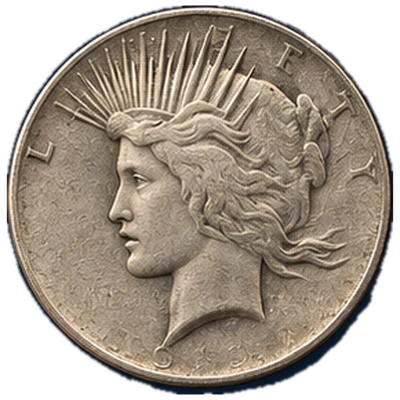
A postwar peace coin and the relief that broke its dies
The Peace dollar exists because of a melting order. Under the Pittman Act of 1918, more than 270 million stored Morgan dollars were turned into bullion, and the 1921 Morgans were only a stopgap until a new design was ready. Farran Zerbe, a promoter of the hobby who had been president of the American Numismatic Association from 1908 to 1910, pushed the idea of a coin marking peace after World War I. A hurried artists' competition in December 1921 picked Anthony de Francisci's design, and Treasury Secretary Andrew Mellon approved it that same month. The U.S. Mint describes the coin as marking peace between the United States and Germany and honoring what citizens gave up during the war.
De Francisci's Liberty faces left and wears a spiked crown much like the Statue of Liberty's. On the back, an eagle perches on a rock holding an olive branch, with the word PEACE below and the rays of a sun that is out of view rising from the lower right.
The first coins were struck at Philadelphia between December 26 and 31, 1921, with 1,006,473 made despite constant die breaks caused by the high relief. A story that these coins would not stack is a myth, according to Gainesville Coins, which points to a 1921 New York Times report in which bank cashiers found they stacked as well as Morgans. Striking in 1922 began with the same high-relief dies, but by January 10 officials judged the breakage intolerable and told the branch mints to destroy their high-relief dies and wait for new ones. About 35,000 high-relief 1922 dollars had been made, and they were melted. The flatter design ran from then on, and Philadelphia's 51.7 million coins in 1922 are the largest mintage of the series.
Production continued every year through 1928, stopped, and then came back for 1934 and 1935. PCGS says the series has no extreme rarities. The 1928 Philadelphia coin is the key and brings a good price even well worn, while the San Francisco dates, particularly the 1924-S, 1927-S, 1928-S and 1934-S, are hard to find in top mint-state grades. A sharply struck coin with full luster and few bag marks is scarce for nearly any date.
The strangest chapter came decades later. In 1964 the Denver Mint struck 316,076 Peace dollars, and every one was ordered destroyed before release. Rumors say a few left the building with Mint employees, but none has ever surfaced publicly, reportedly out of fear the Treasury would seize it. The Mint brought the design back as a collector coin in 2021 for its 100th anniversary. Meanwhile the common dates from 1921 through 1925 are easy to find from Very Fine up through uncirculated.
What to check on this one
- A 1921 Peace dollar should show noticeably higher relief than any later date; it is the only high-relief year that reached circulation.
- On a 1928 dollar, check for a mint mark near the eagle's wing tip. No letter means the Philadelphia key date; an S means the 1928-S, which is scarce only in top grades.
- Any coin offered as a 1964-D Peace dollar should be treated as fake or illegal to own; none has ever been confirmed outside the Mint.
- On San Francisco dates such as the 1927-S and 1934-S, look for full luster and a sharp strike; that is what separates the expensive mint-state coins from ordinary ones.
Sources: Peace Dollar (1921-1935) category (PCGS CoinFacts); Dollar Coins (U.S. Mint); Morgan Dollar (1878-1921) (CoinWeek); 1921 High Relief Peace Dollar (Gainesville Coins); 1922 Peace Dollar (Gainesville Coins); Pittman Act.