 CoinYearValue
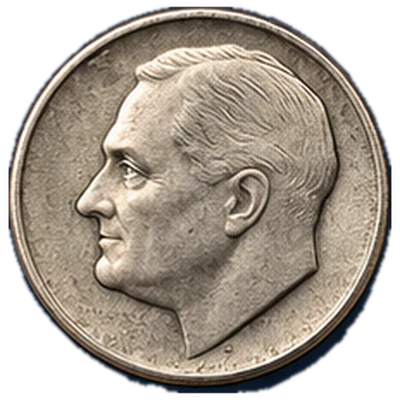
A dime for the president who started the March of Dimes
Franklin Roosevelt died on April 12, 1945, early in his fourth term. He had been diagnosed with polio in 1921 and in 1938 helped found the charity that became the March of Dimes, so the dime was the obvious coin to carry his portrait. It was released on January 30, 1946, which would have been his 64th birthday, and it pushed the Mercury dime out after 30 years.
Chief Engraver John R. Sinnock designed both sides, with Gilroy Roberts assisting. Sinnock had held the post since George Morgan's death in 1925 and died on May 14, 1947. The reverse is a lit torch with an olive branch on the left and an oak branch on the right. Two stories followed the coin. Some Americans decided the JS under the bust stood for Joseph Stalin, and the Mint's attempts to correct that never fully worked; when Sinnock's Franklin half came out in 1948 it carried JRS. Sculptor Selma Burke later said Sinnock based his portrait on her plaque of Roosevelt, and the two profiles are similar, though hers shows a thinner, more worn face.
The silver run lasted 19 years and makes a 48-coin set. San Francisco stopped making dimes after 1955, and that year all three mints had small mintages, with Philadelphia's 12,450,181 the lowest of the silver series. The 1949-S is usually named as the key date, though CoinWeek calls it overrated. Varieties include the 1946 doubled die obverse, the 1947-S doubled die reverse, the 1950-S/D over-mintmark, the 1960 proof doubled die, and doubled reverses on the 1963 and 1964-D. Denver's 1,357,517,180 dimes in 1964 were the most of any silver year.
The Coinage Act of 1965 ended silver dimes for circulation, and mint marks disappeared until 1968, when they returned on the obverse above the date. Clad output reached 2,244,007,320 dimes dated 1967, and Philadelphia began using a P in 1980. Missing mint marks make up the best clad varieties: the 1982 no-P business strike is the only circulating Roosevelt dime that lost its intended mint mark, while proof dimes without the S exist for 1968, 1970, 1975 and 1983. Only two 1975 no-S proofs are known. For the coin's 50th birthday in 1996, West Point struck 1,457,000 dimes with a W for that year's uncirculated sets.
NGC calls the Roosevelt the longest-running U.S. coin design with virtually no changes. In the silver years, graders also look for Full Torch, meaning the horizontal lines across the torch are complete; NGC's census showed only 17 1949-S dimes at MS 67 with that designation. Rare 1965 dimes struck on leftover silver blanks also exist. Dealers otherwise buy worn silver Roosevelts by weight as junk silver, which is what most of the 1946 to 1964 dimes in a coin can end up as.
What to check on this one
- Check the obverse of a 1982 dime above the date. No P means the 1982 no-P variety, and a strong strike brings about twice what a weak one does.
- Weigh a 1965 to 1967 dime that looks silver on the edge. A clad dime is about 2.27 g; one near 2.5 g with no copper stripe may be a transitional error on a silver blank.
- A 1996-W dime has the W above the date and came only in that year's mint sets, so it will not normally turn up in change.
- On proof dimes from 1968, 1970, 1975 and 1983, confirm the S mint mark is there; a missing S on a genuine proof is a major variety.
Sources: What's the 'JS' on the Roosevelt Dime Mean? (PCGS); Carrying a Torch for the Roosevelt Dime (PCGS); Roosevelt Dime, 1946-1964 (CoinWeek); Roosevelt Dime, Clad (1965-Present) (CoinWeek); Jim Bisognani: Roosevelt Dimes Worth the Time (NGC); Building the Ultimate 20th-Century Type Set, Part 2 (CoinWeek).