CoinYearValue

Home / Paper money / Red seal $2 bills

1928 $2 Bill Value

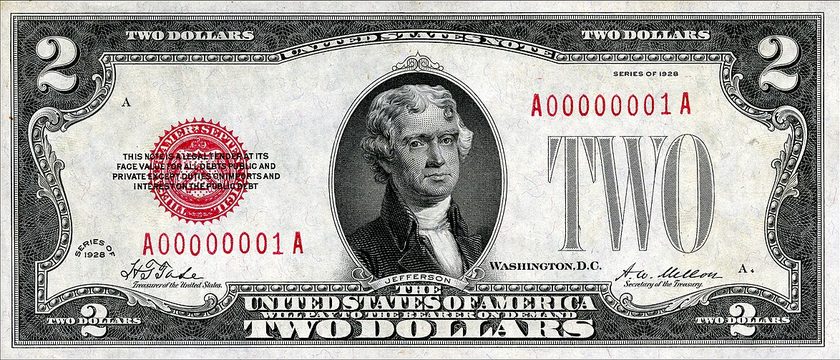
Front of a Series 1928 red seal two-dollar United States Note
A Series 1928 red seal $2 United States Note. The red seal sits on the left on 1928 notes. Image: Wikimedia Commons, public domain.

A worn 1928 red seal $2 bill is worth about $12 to $25. Uncirculated ones sell for about $50 to $90.

The letter after the date matters. A 1928B is the scarce one, worth $50 to $200 even when worn.

Worth keeping. Check the series letter and look for a star before the serial number.

Seven signature pairs on one date: how to read a 1928 $2

Only the notes signed by Treasurer H.T. Tate and Secretary Andrew Mellon were actually printed in 1928. Each letter after that kept the old date and recorded a new pair of officials: Woods and Mellon on 1928A, Woods and Mills on 1928B, Julian and Morgenthau on both 1928C and 1928D, Julian and Vinson on 1928E, Julian and Snyder on 1928F, and Clark and Snyder on 1928G. The series closed out in 1952, so the date on the face says nothing about when your note came off the press.

Series 1928 was also the first $2 with Monticello on the back, a vignette the denomination kept until the 1976 redesign. Within the series, the 1928B is the scarce letter. Its printing came in under 10 million notes, small for a $2, and its star version is the key to the whole set: Numismatic News counts only 8 known.

Several design details shifted inside the series. Between the B and C plates, the legal tender clause on the face went from four lines of text to three. In 1950, between F and G, the face design was made slightly narrower. A 1939 switch to larger plate check numbers left old and new plates running side by side, which produced mules: 1928C mules pair small face numbers with a large back number, and 1928D mules do the reverse. Heritage has noted only nine reported examples of the 1928C mule from the B-A block.

The E is a short series for a different reason. Fred Vinson was Treasury Secretary for less than a year in 1945 and 1946, and the 1928E printing amounted to about 4.4% of the 1928D total. PMG had graded just 30 of the 1928E star notes as of March 2026.

What to check on this one

  • Read both signatures. Woods and Mills means 1928B; if the letter after the date is hard to see, the names settle it.
  • Count the lines of the legal tender text on the face: four lines on 1928 through 1928B, three from 1928C on.
  • On a 1928C or 1928D, compare the size of the small plate number on the face with the one on the back under a loupe. Mismatched sizes mean a mule.
  • A star note signed Julian and Vinson is a 1928E star, one of the hardest red seal $2 stars to find.

Sources: United States two-dollar bill; 1928 $2 Legal Tender or United States Notes (CoinSite); Red is the seal color of U.S. Notes (Numismatic News); Red Seal Small Size Notes $1, $2 and $5 (Numismatic News); Notes from Washington: Serial Number Ranges for $2 1928 Red Seals (Numismatic News); Fr. 1504 $2 1928C Mule Legal Tender (Heritage Auctions); Excessively Rare 1928E $2 Star Note to Highlight Stack's Bowers Currency Rarities Night (CoinWeek); $2 Note (Bureau of Engraving and Printing).

Which one do you have?

  • It has a red seal on the left and red serial numbers, and says UNITED STATES NOTE at the top.
  • The series date, such as SERIES OF 1928 or SERIES OF 1928 D, is printed on the face. Letters run from A to G.
  • The back shows Monticello, Jefferson's home.

Versions worth more

  • 1928B

    $50–200 worn; stars $260–600

    The scarcest of the 1928 letters. Check the series date closely.

  • Star note

    $75–200

    A star (★) before the serial number. 1928 red seal stars are scarce, especially in nice condition.

  • Certified uncirculated

    $110–190 in PMG 64

    Common letters like 1928D and 1928G in high grade.

Check your serial number

Type the 8 digits of the serial number. Add the letters and the star if your note has them; the checker reads the digits.

Questions

Why does my $2 bill have a red seal?

Red seals mark United States Notes, a type of paper money issued by the Treasury rather than the Federal Reserve. Small-size red seal $2 bills were printed with series dates 1928, 1953 and 1963.

Is a 1928 $2 bill silver?

No. It's a United States Note, not a silver certificate. Its value comes from collectors, not metal.

Is old paper money still legal tender?

Yes. All U.S. paper money issued since 1861 is still legal tender at face value. Collectors usually pay more for older or crisp notes.

Where can I sell it?

For common notes, a local coin or currency dealer is quickest. eBay works for notes worth $20 or more. Send notes worth several hundred dollars to a currency auction house.

Should I get it graded?

Only if it's worth well over $100. Grading by PMG or PCGS Banknote costs tens of dollars per note plus shipping, which is more than most common notes are worth.

Check real sales

Sold listings show what notes in your condition actually bring: see sold 1928 $2 bills on eBay.

Protect your notes: currency sleeves keep bills flat and clean, and a 10x loupe helps you read seals and serial numbers.

As an Amazon Associate I earn from qualifying purchases. As an eBay Partner Network affiliate, we may also earn a commission when you buy through links on this site, at no extra cost to you.

More red seal $2 bills: every series and value. All notes: paper money values.

Values checked October 9, 2026 against recent sold listings. They are typical prices, not offers. Worn modern notes are valued at face, since that is what a bank or store gives you. How values work.