CoinYearValue

Home / Paper money / Red seal $2 bills

1953 $2 Bill Value

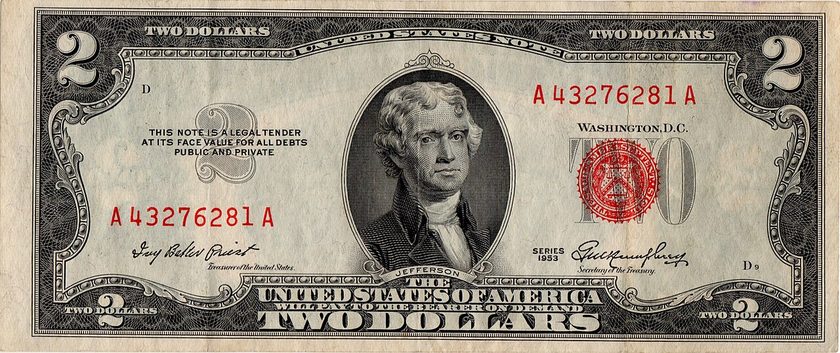
Front of a Series 1953 red seal two-dollar United States Note
A Series 1953 red seal $2 bill. From 1953 the red seal moved to the right, over the large gray word TWO. Image: Wikimedia Commons, public domain.

A worn 1953 red seal $2 bill is worth about $7 to $14. An uncirculated one sells for about $13 to $25.

Star notes bring about $20 to $36 worn and $48 to $90 uncirculated.

Worth more than face. Look for a star in front of the serial number.

1953: the $2 redesign that put the red seal on the right

For 1953 the Treasury shrank the red seal and moved it to the right side of the face, printed over a large gray word TWO. The United States Note obligation went on top of a gray numeral 2. Nothing changed on the back.

The four letters each mark a different pair of officials. Series 1953 carries Ivy Baker Priest and George Humphrey. On 1953A, Robert Anderson replaced Humphrey. Elizabeth Rudel Smith and C. Douglas Dillon signed 1953B, and Kathryn O'Hay Granahan and Dillon signed 1953C. Printing started in 1953, yet the later letters are much younger than their date. Smith did not become Treasurer until January 1961 and Granahan until January 1963, so a 1953C was printed about a decade after the year on its face.

A 1976 Federal Reserve Bank of Richmond review put the whole 1953 series at roughly 80 million notes. Stars were a tiny share of that, and the 1953C star is the shortest, with only 360,000 made. Full uncut sheets are rare too: a 1997 count found just 26 sheets of Series 1953 $2 notes.

Watch for faded or off-color seals sold as errors. PMG examined a 1953B whose seal and serials had turned yellowish after a chemical treatment, probably someone trying to remove stains. The seal and numbers are printed in one pass with one ink, so a note with two shades on it was altered after it left the BEP. CoinWeek found such altered 1953 notes promoted on eBay as errors, one selling for $406, though none had been certified by a major grading service.

What to check on this one

  • The seal and serial numbers should be one even, strong red. Yellow or orange patches mean chemical damage, not a printing error.
  • Granahan and Dillon signed both 1953C and 1963. Look for IN GOD WE TRUST on the back; it is missing on every 1953 letter.
  • A star note signed Granahan and Dillon with a 1953C date is the smallest star run of the series.

Sources: United States two-dollar bill; Series 1953 United States $2 and $5 Notes: A Collector's Guide (CoinWeek); The $2 bill reissue, Economic Review 1976 (Federal Reserve Bank of Richmond); Collecting $2 Bills Dated From 1862 to the Present (CoinWeek); Counterfeit Detection: Altered $2 Legal Tender Note (PMG); Three $2 Bills Worth Money on eBay (CoinWeek); Treasurer of the United States.

Which one do you have?

  • It has a red seal on the right, printed over the large gray word TWO, and red serial numbers.
  • The series date reads SERIES 1953, 1953 A, 1953 B or 1953 C. Values are about the same for each.
  • The back shows Monticello and does not say IN GOD WE TRUST.

Versions worth more

  • Star note

    $20–36 worn, $48–90 uncirculated

    A star (★) before the serial number.

  • Certified star note

    $66–100 in PMG 63

    Graded stars in better grades bring more.

Check your serial number

Type the 8 digits of the serial number. Add the letters and the star if your note has them; the checker reads the digits.

Questions

How can I tell a 1953 from a 1963 $2 bill?

Read the series date on the front, then turn it over. The 1963 back adds IN GOD WE TRUST above Monticello; the 1953 back does not.

Is old paper money still legal tender?

Yes. All U.S. paper money issued since 1861 is still legal tender at face value. Collectors usually pay more for older or crisp notes.

Where can I sell it?

For common notes, a local coin or currency dealer is quickest. eBay works for notes worth $20 or more. Send notes worth several hundred dollars to a currency auction house.

Should I get it graded?

Only if it's worth well over $100. Grading by PMG or PCGS Banknote costs tens of dollars per note plus shipping, which is more than most common notes are worth.

Check real sales

Sold listings show what notes in your condition actually bring: see sold 1953 $2 bills on eBay.

Protect your notes: currency sleeves keep bills flat and clean, and a 10x loupe helps you read seals and serial numbers.

As an Amazon Associate I earn from qualifying purchases. As an eBay Partner Network affiliate, we may also earn a commission when you buy through links on this site, at no extra cost to you.

More red seal $2 bills: every series and value. All notes: paper money values.

Values checked October 9, 2026 against recent sold listings. They are typical prices, not offers. Worn modern notes are valued at face, since that is what a bank or store gives you. How values work.