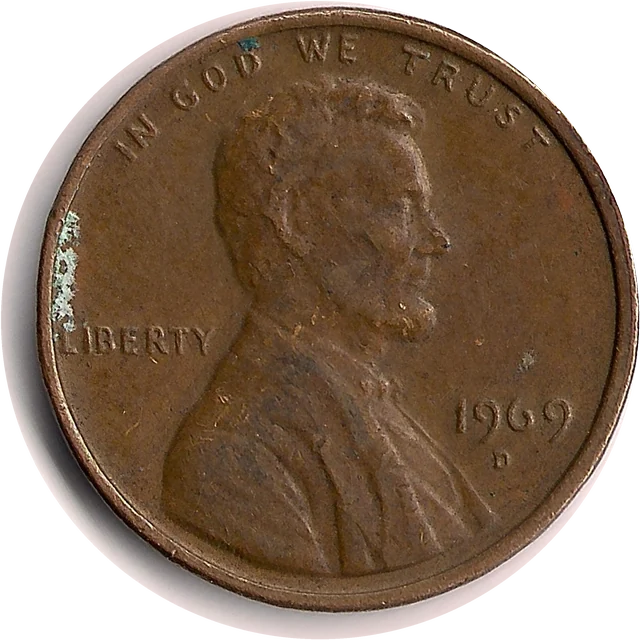
Small date, large date and the great bag hunt
Early in 1960 the Mint changed the hub and made the date larger, to cut down on the inside of the 0 breaking away during striking. Far fewer small-date cents came out of Philadelphia than large-date ones. Once collectors found out, they started buying sealed bags of new cents, hoping to land the rare version. Small-date bags of 5,000 coins reportedly traded for around $10,000, or about $2 a coin, and the highest reported prices reached $12,000 a bag before the bubble burst in 1964. People holding mostly Philadelphia small-date bags were the ones who came out ahead.
PCGS specialist Jaime Hernandez rates the 1960 small date from Philadelphia as the scarcer of the two Philadelphia versions, and PCGS estimates about 130,000 red examples survive in all grades, roughly half of them MS65 or better. PCGS also notes that the Denver small date is scarcer than the Denver large date.
The hub change produced the first Lincoln cents showing two date sizes on one coin, apart from a 1949-S doubled die. Three proof dies are known with one date size over the other, and only a single Denver business-strike die, which also has a strong repunched D. 1960 is a magnet for variety collectors in general. CopperCoins says the year produced the strongest repunched mint mark in the Lincoln series, lists nearly 200 known RPM dies, and puts a complete set of the year's known varieties at more than 200 coins, the most for any Lincoln cent date.
What to check on this one
- Use a 10x loupe on the date: on a small date the top of the 9 is nearly level with the top of the 1, and the final 0 is smaller with an oval-looking center.
- Faint doubling inside the E of WE shows on most large-date coins; it is master die doubling and carries no premium.
- On a 1960-D, look at the date for traces of a larger date under a small one, and at the D for a second D; together they are the small over large variety.
Sources: Lincoln cent (Wikipedia); Looking for the 1960 Large & Small (PCGS); 1960 1C Small Date, RD, PCGS CoinFacts; 1960 Lincoln Cent Date Guide (CopperCoins).
Advertisement
Value by grade and mint mark
What each 1960 penny is worth, by grade and mint mark| Grade | No mark | D |
|---|
| GoodGood G4Heavily worn; date and letters still readable | 5¢ | 5¢ |
|---|
| FineFine F12Worn, but all the main lettering is clear | 5¢ | 5¢ |
|---|
| Very FineV. Fine VF20Light to moderate wear on the high spots | 5¢ | 5¢ |
|---|
| Extremely FineEx. Fine EF40Light wear on the highest spots only | 5¢ | 5¢ |
|---|
| About UncirculatedAbout Unc. AU50Traces of wear, some original shine | 5¢ | 5¢ |
|---|
| UncirculatedUnc. MS60No wear, but plenty of marks | 5¢ | 5¢ |
|---|
| Choice UncirculatedChoice Unc. MS63No wear and only a few marks | 10¢ | 10¢ |
|---|
| Gem UncirculatedGem Unc. MS65Certified and nearly flawless | $13 | $15 |
|---|
Good through About Uncirculated are for coins as found, not in a grading holder. MS60 and MS63 are uncirculated coins; MS65 is a coin certified by PCGS or NGC. Values are for the common large date. Small dates are worth more; see the varieties below. For cents, MS60 and MS63 values are for brown coins, and red ones bring more. MS65 values are for coins with full original red color; brown and red-brown ones sell for less. Values checked November 15, 2026 against public price guides and auction records. How values work.
What a 1960 penny looks like
Varieties and errors to check
1960 small date
Look for: A small date with the top of the 1 even with the top of the 9.
Scarcer than the large date and worth more.
Typical value: 50¢–$3
Source
1960-D small date
Look for: Small date with a D below it.
Worth a small premium over the large date.
Typical value: 5–25¢
Source
1960-D, D over D, small date over large date
Look for: A second D at the mint mark and traces of a large date under the small date.
A recognized combined variety with a premium.
Typical value: $15–50
Source
Find the mint mark
Front of the coin, just below the date. Philadelphia cents have no letter, and neither do the 1964 cents struck in San Francisco or the cents struck at West Point from 1974.
What it's made of
- Bronze (95% copper, 5% tin and zinc), 3.11 grams, about 4¢ of copper
Melting cents and nickels is not allowed under U.S. Mint rules, so copper and nickel value is a guide only.
Mintage
How many were made| Coin | Type | Mintage |
|---|
| 1960-D | For circulation | 1,580,884,000 |
|---|
| 1960 (no mint mark) | For circulation | 586,405,000 |
|---|
| 1960 (no mint mark) | Proof (collector) | 1,691,602 |
|---|
Questions
Is a 1960 penny silver?
No. 1960 pennies are made of bronze (95% copper, 5% tin and zinc).
Which 1960 penny is worth the most?
In MS65, the 1960-D is worth the most, about $15. The 1960-D, D over D, small date over large date is the one to look for: typical examples sell for $15–50.
Where is the mint mark on a 1960 penny?
Front of the coin, just below the date. Philadelphia cents have no letter, and neither do the 1964 cents struck in San Francisco or the cents struck at West Point from 1974.
Check real sales
Recent sold listings show what coins in your condition actually bring: see sold 1960 pennies on eBay.
Keep it safe: coin holders and a 10x loupe for checking details and mint marks.
As an Amazon Associate I earn from qualifying purchases. As an eBay Partner Network affiliate, we may also earn a commission when you buy through links on this site, at no extra cost to you. Affiliate disclosure.
 CoinYearValue