 CoinYearValue
How to tell if a U.S. coin is silver
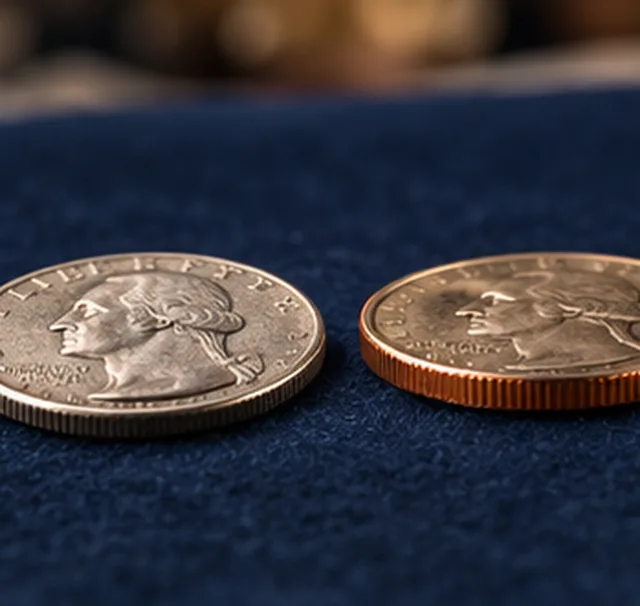
Most of the work is done by the date. A U.S. dime, quarter or half dollar dated 1964 or earlier is 90% silver, and a dime or quarter dated 1965 or later is not, apart from a few collector issues. After the date, the two checks that settle almost every case are the edge and the weight. An inexpensive pocket scale that reads to 0.01 gram will tell you more than any trick with a magnet or a dropped coin.
Dates that mean silver
The Coinage Act of 1965, signed July 23, 1965, took silver out of the dime and quarter and cut the half dollar to 40% silver. The new coins used copper-nickel faces bonded to a pure copper core. A 1970 law ended silver in the half dollar entirely, starting with 1971 coins.
| Coin | Silver dates | Silver content |
|---|---|---|
| Dime | 1964 and earlier | 90% |
| Quarter | 1964 and earlier | 90% |
| Half dollar | 1964 and earlier | 90% |
| Half dollar | 1965 to 1970 | 40% |
| Nickel | Late 1942 to 1945, large mint mark over Monticello | 35% |
| Dollar (Morgan, Peace) | 1878 to 1935 | 90% |
| Eisenhower dollar | 1971 to 1976, San Francisco collector coins only | 40% |
Look at the edge
Turn the coin on its side. A clad coin made from 1965 on shows a band of copper between two silver-colored layers, because the core is pure copper. On a 90% silver coin the metal is the same all the way through, so the edge is one even gray or white, often darker with age.
The edge check has two blind spots. Dirt and toning can make the stripe hard to see, so tilt the coin under a bright light. And the 40% silver pieces (1965 to 1970 halves, silver Eisenhower dollars, 1976 collector coins) have a core that is itself a silver-copper alloy, so they show no bright copper band even though they are well under half silver. For those, the date and the weight do the work.
What each coin should weigh
Weight is the most reliable home test because silver and clad coins of the same size differ by a known amount. Use a scale with two decimal places in grams. A kitchen scale that rounds to 1 gram cannot tell a silver dime from a clad one.
| Coin | Silver version | Non-silver version |
|---|---|---|
| Dime | 2.50 g (90%) | 2.268 g (clad) |
| Quarter | 6.25 g (90%) | 5.67 g (clad) |
| Half dollar | 12.50 g (90%), 11.50 g (40%) | 11.34 g (clad) |
| Nickel | 5.00 g (35% wartime) | 5.00 g (copper-nickel) |
| Morgan or Peace dollar | 26.73 g (90%) | none |
| Eisenhower dollar | about 24.6 g (40%) | 22.68 g (clad) |
Heavy wear takes a little metal off, so allow a small shortfall on an old, smooth coin. The weight test fails in two places: wartime nickels weigh the same as regular nickels, and a 40% half at 11.50 g is only 0.16 g heavier than a clad half, so a worn 40% half can overlap a fresh clad one. For the silver value of each coin, plug the date into the melt value calculator.
Weighing also catches errors. A 1965 quarter that weighs about 6.25 g and has no copper on the edge may have been struck on a leftover silver blank, which is a rare and valuable mistake.
Why the magnet test proves little
Silver is diamagnetic, which means a magnet pushes on it so weakly that only lab instruments can detect it. Copper behaves the same way. Since clad coins are mostly copper, a household magnet will not stick to a silver quarter or a clad quarter, and you learn nothing about which one you have.
The magnet does catch one thing: a fake or a coin with a steel or iron core. If a coin that is supposed to be silver jumps to a magnet, it is not silver. When it doesn't stick, you have only ruled out steel.
The ring test and its limits
Plenty of people balance a coin on a fingertip, tap it with another coin and listen for a long ring. The sound depends on the coin's size, its wear, any hidden crack, the coin you tap it with and your own ear. Try it on a known silver coin and a known clad coin of the same size first. If you can't hear a clear difference between those two, the test won't help you on an unknown one. Never drop coins on a hard floor or counter to listen to them, since a nick on the rim lowers the value of a collectible coin. Use the scale instead.
40% silver half dollars, 1965 to 1970
Kennedy halves from 1965 through 1970 weigh 11.50 g. Their outer layers are 80% silver bonded to a core of about 21% silver, which works out to 40% overall and 0.14792 troy ounces of silver per coin. The 1970 half was struck for regular sale only at Denver and was sold only in mint sets, with about 2.1 million made, so a 1970-D in your change jar is unusual. Starting in 1971 the half is copper-nickel clad at 11.34 g. The 1966 half dollar page shows what a typical 40% half is worth at today's silver price, and the 1964 half dollar shows the 90% version for comparison.
War nickels, 1942 to 1945
To save nickel for the war, the Mint switched the five-cent piece to 56% copper, 35% silver and 9% manganese, starting in October 1942 and running through 1945. These coins carry a large mint mark above Monticello's dome on the back. The P on Philadelphia coins was the first time that mint ever put its letter on a U.S. coin. Each one holds 0.05626 troy ounces of silver.
1942 is the tricky year, because both alloys were made. A 1942 nickel with a small D or no mint mark beside Monticello is regular copper-nickel; one with a large P or S above the dome is silver. 1943 to 1945 nickels are all silver, and they should all have a large mint mark. A 1944 nickel without one is a counterfeit, made in the 1950s by a forger named Francis LeRoy Henning. See the 1943 nickel for current values and the 1943/2 overdate.
Eisenhower dollars with an S mint mark
Every Eisenhower dollar you got in change, or from a bank roll, is copper-nickel clad at 22.68 g. The 40% silver ones were struck only at San Francisco for collectors from 1971 to 1974, plus the 1776-1976 Bicentennial silver pieces. The uncirculated silver coins were sold in blue envelopes and the proofs in brown boxes stamped with a gold eagle, which gave collectors the nicknames blue Ike and brown Ike. A silver Ike weighs about 24.6 g and holds about 0.316 troy ounces of silver.
An S on the front is not proof of silver by itself, because San Francisco also struck clad proofs. Weigh it. The 1971 silver dollar page has values for both types.
Bicentennial and proof silver
For 1976 the Mint sold 40% silver quarters and halves in collector sets alongside the clad coins made for circulation. The clad ones are far more common; check the 1976 quarter page before assuming yours is silver. Silver proof sets have been sold since 1992. Their dimes, quarters and halves were 90% silver through 2018 and .999 fine silver from 2019 on.
Common mistakes
- Assuming a 1964 nickel is silver because 1964 dimes and quarters are. It is regular copper-nickel.
- Treating every half dollar as 90%. Only 1964 and earlier halves are; 1965 to 1970 are 40%, and 1971 and later have none in circulation.
- Relying on a magnet or the sound of a coin instead of a scale.
- Cleaning or scratching a coin to see what's underneath. That damage can turn a collectible coin into a melt-value coin.
- Using a kitchen scale with 1-gram steps. The difference between a silver and clad dime is about a quarter of a gram.
Supplies mentioned in this guide
As an Amazon Associate I earn from qualifying purchases. These are paid links. Affiliate disclosure.
Questions
Are 1965 quarters silver?
No. Regular 1965 quarters are copper-nickel clad and weigh 5.67 grams. The rare exception, struck by mistake on a leftover 90% blank, comes in near 6.25 grams and has no copper stripe on the edge.
How much silver is in a pre-1965 dime, quarter and half?
A 90% silver dime holds 0.07234 troy ounces, a quarter 0.18084 and a half dollar 0.36169. For a 1965 to 1970 half, the figure is 0.14792 troy ounces.
Will a magnet stick to a silver coin?
No, but it won't stick to a clad coin either, because both silver and copper are only very weakly diamagnetic. A magnet only catches fakes with steel or iron in them.
Are 1971 half dollars silver?
No. Starting with 1971, half dollars made for circulation are copper-nickel clad and weigh 11.34 grams.
Sources
Checked October 19, 2026. See our editorial policy for how we source facts.