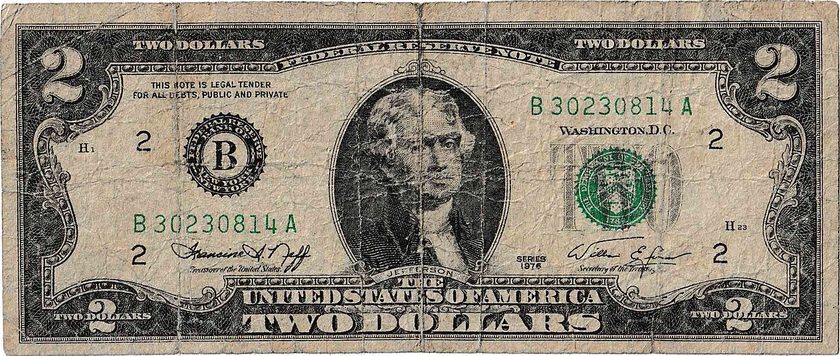
A Series 1976 $2 bill after decades in circulation. Most 1976 notes look like this. Image: Wikimedia Commons, public domain.
A worn 1976 $2 bill is worth about face value, $2 to $4. An uncirculated one sells for about $8 to $17.
Star notes and bills stamped on the first day of issue bring more. Check your serial number below.
Spend it or keep it as a keepsake, unless it's a star note, first-day stamped, or has a fancy serial number.
Worn$2–4Folds, soft paper, normal wear
Uncirculated$8–17Crisp, no folds, never spent
Star note$10–35Star (★) in the serial number
Why the Treasury brought the $2 back in 1976
Treasury Secretary William Simon announced the new $2 on November 3, 1975, and the main argument for it was cost. The Richmond Fed explained at the time that if twos replaced about half of the ones in use, the government would save roughly $27 million from 1976 to 1981 in printing, handling and shipping. It was meant as a permanent denomination, with no collector editions planned.
The notes became available on April 13, 1976, Jefferson's 233rd birthday. The opening supply was 225 million notes, and the BEP was turning out about 11 million a day. By the time the last run finished in 1978, it had printed 590,720,000 Series 1976 $2 bills. The public never took to them. Some store clerks questioned whether the bills were real, and in a few cases people trying to spend them were arrested.
The back engraving, adapted by BEP engraver Peter Cocci, is based on John Trumbull's painting of the Declaration of Independence. The painting has 47 men in it, but there wasn't room for all of them on the note, so 5 were left out.
Collector money in this series is in the replacement notes. CoinWeek names the Kansas City star, district J, as the scarcest, and Minneapolis stars are also hard to find. Serial number 1 from the San Francisco district sold at Heritage for $21,150 on January 8, 2016.
What to check on this one
Look at the letter in the black seal on the left. A star note from J (Kansas City) or I (Minneapolis) is the one to set aside.
Very low serial numbers, such as 00000001 through 00000100, are worth showing a currency dealer.
A first-day note needs the stamp and the April 13, 1976 postmark on the note itself. A loose stamp or a later date does not count.
The front says SERIES 1976 next to Jefferson's portrait, on the right.
The seal on the right is green, and the black seal on the left shows a letter for the Federal Reserve Bank that issued it.
The back shows the signing of the Declaration of Independence, adapted from John Trumbull's painting.
The signatures are Francine I. Neff (Treasurer) and William E. Simon (Secretary of the Treasury).
Versions worth more
Star note
$10–35 worn, $20–35 uncirculated
A star (★) at the end of the serial number marks a replacement note. Uncirculated stars from small print runs sell for the most.
First-day stamped
$12–23
On April 13, 1976, the day the bill came out, many people stuck a 13-cent stamp on the back and had the post office cancel it with that date. Look for a postmark dated APR 13 1976.
Certified uncirculated
about $105 for a star in PMG 65
Graded notes in top condition, especially stars, bring the highest prices.
Fancy serial number
$20–35 typical
Radar, repeater, solid and low serial numbers add value. Use the checker on this page.
Check your serial number
Type the 8 digits of the serial number. Add the letters and the star if your note has them; the checker reads the digits.
Questions
Is a 1976 $2 bill rare?
No. Hundreds of millions were printed, and many were saved as souvenirs, so worn ones are common. Uncirculated notes, star notes and first-day stamped notes are the ones collectors pay extra for.
Can I still spend a 1976 $2 bill?
Yes. All U.S. paper money issued since 1861 is still legal tender at face value.
Is old paper money still legal tender?
Yes. All U.S. paper money issued since 1861 is still legal tender at face value. Collectors usually pay more for older or crisp notes.
Where can I sell it?
For common notes, a local coin or currency dealer is quickest. eBay works for notes worth $20 or more. Send notes worth several hundred dollars to a currency auction house.
Should I get it graded?
Only if it's worth well over $100. Grading by PMG or PCGS Banknote costs tens of dollars per note plus shipping, which is more than most common notes are worth.
Protect your notes: currency sleeves keep bills flat and clean, and a 10x loupe helps you read seals and serial numbers.
As an Amazon Associate I earn from qualifying purchases. As an eBay Partner Network affiliate, we may also earn a commission when you buy through links on this site, at no extra cost to you.
Values checked October 9, 2026 against recent sold listings. They are typical prices, not offers. Worn modern notes are valued at face, since that is what a bank or store gives you. How values work.
 CoinYearValue