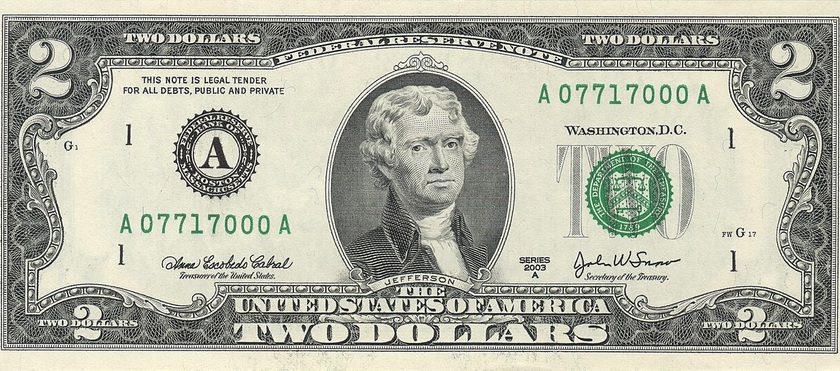
Series 2003A shown. A 1995 note has the same design; only the series date, seal letter and signatures differ. Image: Wikimedia Commons, public domain.
A worn 1995 $2 bill is worth face value, $2 to $3. A crisp uncirculated one sells for about $4 to $8.
Star notes bring about $10 to $19. Check your serial number below for patterns that add value.
Worth face value unless it's uncirculated, a star note, or has a fancy serial number.
Worn$2–3Folds, soft paper, normal wear
Uncirculated$4–8Crisp, no folds, never spent
Star note$10–19Star (★) in the serial number
1995: the first $2 printed in Texas
Series 1995 was the first $2 note printed at the BEP's Western Currency Facility in Fort Worth, Texas, which began printing currency in 1990 as the first BEP plant outside Washington, D.C. Every $2 since has come from Fort Worth. The notes carry the signatures of Mary Ellen Withrow and Robert Rubin, a pair that appears on no other $2, since Series 2003 went to Rosario Marin and John Snow.
The regular printing went to a single Federal Reserve district. All 153,600,000 notes, printed in 1996 and 1997, were made for the Atlanta bank, so an ordinary 1995 $2 has the Atlanta seal on the left.
The interesting exception came at the end of 1999, when the BEP made a special run of 9,999 Series 1995 star notes for all twelve Federal Reserve Banks. Collectors know them as millennium stars, and auction listings show serials that begin with 2000. Next to the regular printing that is a tiny run, about one star for every 15,000 Atlanta notes.
Series 1995 ended a long gap. The last Series 1976 notes had been printed in 1978, so nearly two decades passed with no new $2 coming off the presses. The design itself came over from 1976 without changes beyond the signatures and series. By coincidence, the Fed's fiscal 2019 order for the later Series 2017A was the same size as this run, 153.6 million notes.
What to check on this one
A regular Series 1995 note should show the Atlanta seal and a serial starting with F. If yours has another bank's seal, check whether it is a star from the 1999 run.
On a star note, check whether the serial starts with 2000. That marks the millennium printing, which sells above ordinary stars.
Read the signatures: Withrow and Rubin. Later $2 series carry different names.
The front says SERIES 1995 to the right of Jefferson.
The signatures are Mary Ellen Withrow (Treasurer) and Robert E. Rubin (Secretary of the Treasury).
The seal on the left shows the issuing Federal Reserve Bank. The serial number starts with the matching letter.
Versions worth more
Star note
$10–15 worn, $11–19 uncirculated
A star (★) at the end of the serial number marks a replacement note.
Fancy serial number
$25–32 typical
Radar, repeater and low serial numbers bring a premium.
Check your serial number
Type the 8 digits of the serial number. Add the letters and the star if your note has them; the checker reads the digits.
Questions
Is a 1995 $2 bill rare?
No. It is common in circulated condition and worth face value. Uncirculated notes and star notes sell for a small premium.
Is old paper money still legal tender?
Yes. All U.S. paper money issued since 1861 is still legal tender at face value. Collectors usually pay more for older or crisp notes.
Where can I sell it?
For common notes, a local coin or currency dealer is quickest. eBay works for notes worth $20 or more. Send notes worth several hundred dollars to a currency auction house.
Should I get it graded?
Only if it's worth well over $100. Grading by PMG or PCGS Banknote costs tens of dollars per note plus shipping, which is more than most common notes are worth.
Protect your notes: currency sleeves keep bills flat and clean, and a 10x loupe helps you read seals and serial numbers.
As an Amazon Associate I earn from qualifying purchases. As an eBay Partner Network affiliate, we may also earn a commission when you buy through links on this site, at no extra cost to you.
Values checked October 9, 2026 against recent sold listings. They are typical prices, not offers. Worn modern notes are valued at face, since that is what a bank or store gives you. How values work.
 CoinYearValue