CoinYearValue
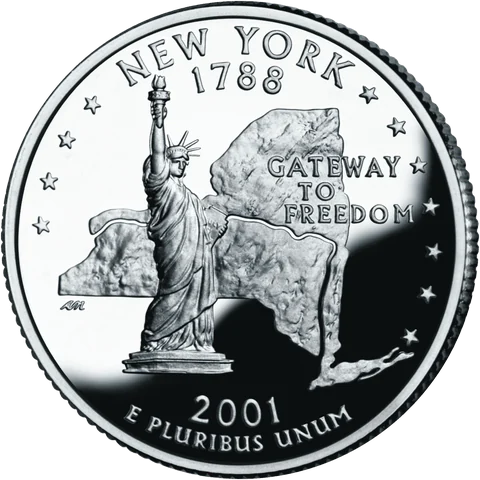
New York's nearly 1.3 billion, and a lopsided year between Philadelphia and Denver
Output fell to 4,806,984,000 in 2001, down from the 6.47 billion peak of 2000, and it dropped again in each of the next two years. New York opened the year with 1,275,040,000 coins (655,400,000 from Philadelphia, 619,640,000 from Denver). Kentucky closed it with the smallest total, 723,564,000. Denver beat Philadelphia on Rhode Island, Vermont and Kentucky, which hadn't happened with any 2000 design, while North Carolina tilted hard the other way: 627.6 million from Philadelphia and only 427.9 million from Denver.
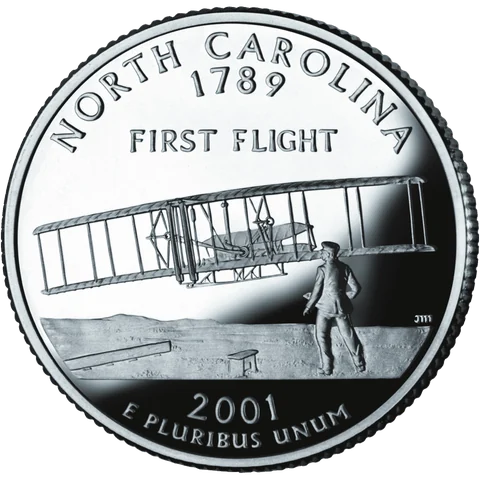
New York's quarter drew complaints from upstate residents who felt the Statue of Liberty belongs to the city. Its state outline carries a line tracing the Hudson River and the Erie Canal, and the 11 stars mark the state's place as the 11th to ratify the Constitution; sculptor Daniel Carr's designs were used for both New York and Rhode Island. North Carolina's coin reproduces John T. Daniels's famous 1903 photograph of the Wright brothers' first flight. Reporters had already pointed out in 2000 that Ohio's aviation ideas overlapped with it.
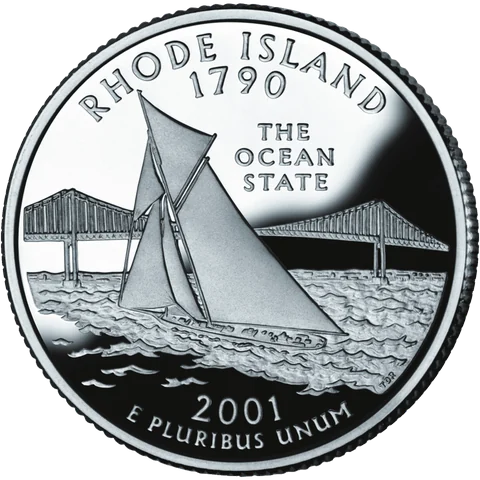
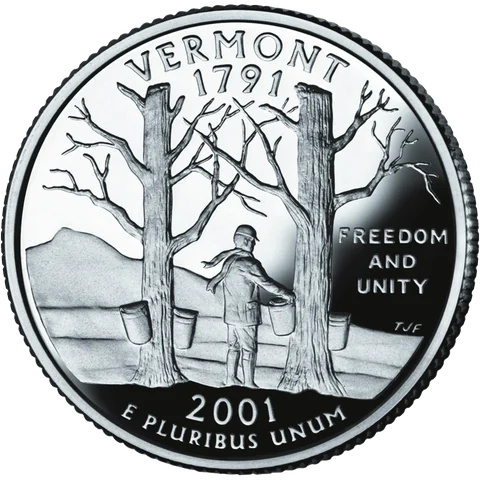
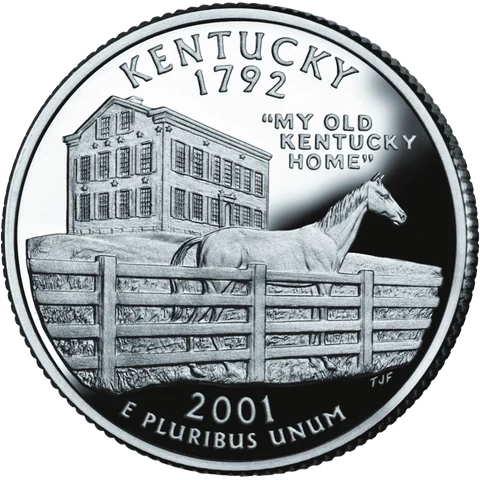
Rhode Island's scene puts the America's Cup yacht Reliance on Narragansett Bay with the Claiborne Pell Newport Bridge behind it, a pairing that never happened: Reliance was sold for scrap in 1913, and the bridge opened in 1969. Vermonters argued over whether Camel's Hump should be drawn from the east or the west, and the final design adds maple trees hung with sap buckets. Kentucky's design puts a racehorse behind a fence in front of Federal Hill in Bardstown, under the words "My Old Kentucky Home."
No major variety is on record for 2001, so what separates these issues is the mintages above.
What to check on this one
- North Carolina: compare Philadelphia and Denver coins. The Denver run was about 200 million smaller, so a sharp uncirculated D is the one to set aside.
- On an S proof, look at the edge. A plain silvery edge with no copper stripe is the 90% silver version; a copper stripe means clad.
Sources: State quarter coin production figures by U.S. Mint, year and state (CoinNews); 50 State quarters (Wikipedia); States hark back in choice of designs for quarters (Stateline); State quarter mintages (CoinNews, 2007).