 CoinYearValue
The Moon-landing dollar that never caught on in pockets
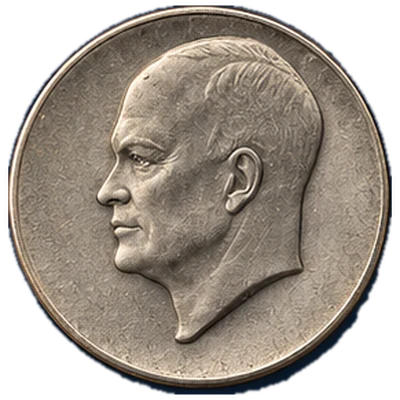
Congress authorized a new dollar coin in 1970 to honor two things at once: Dwight Eisenhower, who had recently died, and the first landing on the Moon. It was the first dollar the Mint had issued since the Peace dollar ended in 1935, and the first circulating dollar made without silver or gold. Frank Gasparro designed both sides. His reverse copies the Apollo 11 mission insignia, an eagle landing on the Moon, minus the mission's name, a fitting tie since NASA was created during Eisenhower's presidency.
Two versions were made from the start. Coins for circulation were copper-nickel clad, while 40% silver uncirculated and proof coins were sold to collectors at a premium. PCGS lists six reverse die varieties among the non-proof coins, some found only on certain dates, such as one that appears only on 1971-D coins. The 1972 Philadelphia dollar comes with three reverse types, and the Type 2 is the valuable one. Low-relief and high-relief versions of the 1971 and 1972 coins give variety collectors more to sort.
For the Bicentennial, the Treasury held a national competition with a $5,000 award for each new reverse. The dollar went to Dennis R. Williams, then just 22 and a sculpture student at the Columbus College of Art and Design in Ohio, whose instructor had assigned the contest rules as a class project. His design sets the Liberty Bell over the Moon, and dual-dated 1776-1976 dollars went out on October 13, 1975, so no Eisenhower dollar carries a 1975 date. These come in two varieties. Variety 1 has low relief and thick, plain lettering, and the bottom tail of the second S in STATES sits noticeably higher than the lowest bar of the E. Variety 2 has sharper, higher relief with thinner lettering that has serifs. The Mint had planned on about 300 million Bicentennial dollars, but circulating output stopped at 220.6 million when production ended late in 1976, even after a spring surge in which dollar output ran 260 percent above the year before.
The coin was large and heavy, and it saw little use in ordinary spending. Littleton calls it the last large-size circulating U.S. dollar. Production ended with 1978 dates, and the much smaller Susan B. Anthony dollar replaced it in 1979, borrowing the same Apollo 11 eagle for its reverse.
Most Eisenhower dollars are common and inexpensive, and a complete set of business strikes, silver pieces and proofs costs far less than a set of cents or quarters. The catch is grade. Writing for CoinWeek, Charles Morgan points out that the Red Book prices these dollars only up to MS63, while collectors actually trade them in MS65 and MS66, where gem clad coins are scarce and sell for several times more. He calls the series a noble failure.
What to check on this one
- On a 1776-1976 dollar, look at the reverse lettering: thick block letters mean Variety 1, thin letters with serifs mean Variety 2. The tail of the second S in STATES is a quick test.
- A 1972 dollar from Philadelphia should be checked for its reverse type; the Type 2 reverse is the one that carries a premium and is best confirmed by a grading service.
- Weigh an S-mint dollar: about 24.59 g means 40% silver, about 22.68 g means a clad collector coin.
- For uncirculated clad dollars, check the cheek and the eagle for bag marks; value depends on reaching MS65 or better.
Sources: Ike Dollar (1971-1978) category (PCGS CoinFacts); Dollar Coins (U.S. Mint); 40 Years Since U.S. Bicentennial Coins First Hit Pocket Change (CoinWeek); Bicentennial Coins and Medals (U.S. Mint); When Dealing With Eisenhower Dollars, Grade Is Everything (CoinWeek); Collectors Enjoy Ike Dollars, Last Large-Size Circulating $1 Coins (Littleton Coin Company).