 CoinYearValue
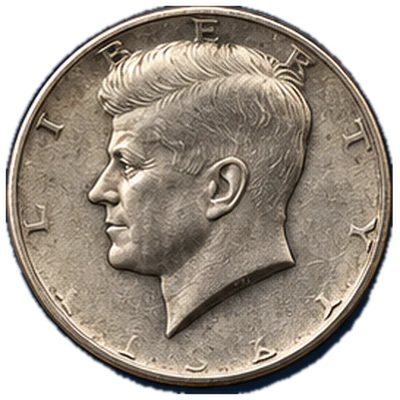
A half dollar made in weeks after November 1963
The Kennedy half came together fast because most of it already existed. Chief Engraver Gilroy Roberts had cut a Kennedy portrait in 1961 for the Mint's series of presidential medals, and Frank Gasparro's reverse from that same medal, an eagle adapted from the presidential seal, was ready too. The obverse sets IN GOD WE TRUST in a straight line above the date, with LIBERTY curving around the top. Mint Director Eva Adams started the work right after the assassination. The first idea was the quarter, but Jacqueline Kennedy did not want Washington displaced, and on November 27, 1963 the Mint was told to work on the half dollar instead. Congress then passed the law that put Kennedy on the coin from 1964.
PCGS says the coin sold at a premium from the moment it was released. Hundreds of millions were struck, yet few entered everyday commerce, and over time the half dollar dropped out of daily use while mintages generally declined. PCGS's list of the top 50 U.S. coins calls the 1964 Kennedy, common as it is, possibly the most popular American coin ever. It was also the only year of 90% silver halves made for circulation. From 1965 through 1970 the half carried a reduced silver-clad composition, and from 1971 it became copper-nickel clad like the dime and quarter.
The rarest Kennedy that is neither an error nor a die variety is a 1964 that was never sold. About 12 examples are known of a 1964 Special Mint Set half with satin surfaces and sharp square rims, and a 2016 Heritage sale brought $47,000, the first public sale of one since 2010. A tiny lump below the 4 in the date, called the dangling 4, is its die marker. Where they came from is unclear; one theory ties them to Eva Adams's estate after her death in 1991. On the regular side, the 1974-D doubled die obverse, a small part of Denver's 79,066,300 halves that year, is, in CoinWeek's view, the lone major doubled die among all Kennedy halves.
For the Bicentennial, Seth Huntington's Independence Hall replaced the eagle, and the dual-dated halves went into circulation on July 7, 1975, so no half is dated 1975. Silver versions were part of the 40% silver three-coin sets. In 2014 the 50th anniversary brought clad, silver and even gold versions.
After 2001, the Federal Reserve stopped ordering halves for circulation, and for two decades the Mint sold Philadelphia and Denver halves only to collectors at a premium. That changed in 2021, when the Fed placed orders again and 2021-P and 2021-D halves began turning up in $500 bank boxes in Virginia, Washington and California. CoinWeek notes that an ordinary clad half from the 1970s in AU or lower grades is worth face value.
What to check on this one
- A 1964 half should have no copper stripe on its edge and weigh about 12.5 g; a 1965 to 1970 half weighs about 11.5 g and still contains silver.
- On a 1974-D, look at IN GOD WE TRUST, LIBERTY and the date for doubling; it is the series' one major doubled die.
- A 1964 with satin surfaces, crisp square rims and a small drop of metal under the 4 needs expert review as a possible Special Mint Set coin.
- A 1776-1976 half with an S mint mark and no copper stripe on the edge is a 40% silver coin from the collector sets, not a circulation piece.
Sources: How Tragedy Shaped the Kennedy Half Dollar (Coin World); Kennedy Half Dollar (1964-Date) category (PCGS CoinFacts); The Franklin Half Dollar Turns 75 (PCGS); The Top 50 U.S. Coins of All Time (PCGS); Rare 1964 SMS Kennedy Half Dollar Sells for $47K (CoinWeek); United States 1974-D Kennedy Half Dollar (CoinWeek); 40 Years Since U.S. Bicentennial Coins First Hit Pocket Change (CoinWeek); 2021-P Kennedy half dollars now being found in circulation (Coin World).