CoinYearValue
Why a worn 1899 Philadelphia dollar is harder to find than a new one
Philadelphia delivered only 330,000 business-strike Morgan dollars in 1899, and it did so in three batches: 76,000 in February, 214,000 in May and 40,000 in December. The Mint's annual report for that year explains why the number stayed small. Philadelphia was busy filling heavy orders for gold and subsidiary silver, so New Orleans handled most of the country's dollar coinage. The 1899-O finished at 12,290,000, about 37 times the Philadelphia total.
A mintage that low has led some dealers over the years to claim the official figure is a misprint. Q. David Bowers sees no reason to doubt it, and the VAM authors Leroy Van Allen and George Mallis agree with him. Possibly 150,000 of the coins were melted early on. Philadelphia also struck 846 proofs, delivered across four months of the year.
What kept the date from becoming a true rarity was government storage. Bags surfaced from the early 1950s into the early 1960s, and dealer Harry J. Forman handled about 10 of them, most coming out of Las Vegas, which was unusual for a Philadelphia issue. More bags appeared in the 1962–1964 Treasury dispersal, first in Montana in early 1963 and later in California and Nevada.
Because so many came out of sealed bags, uncirculated 1899s are easier to locate than worn ones. Bowers put the MS60 to MS62 population alone at 50,000 to 100,000 coins, against only 6,000 to 12,000 circulated survivors. That places the 1899 among roughly the dozen most elusive Morgans in worn grades, and it is why a circulated Philadelphia coin carries a premium that a circulated 1899-O does not.
What to check on this one
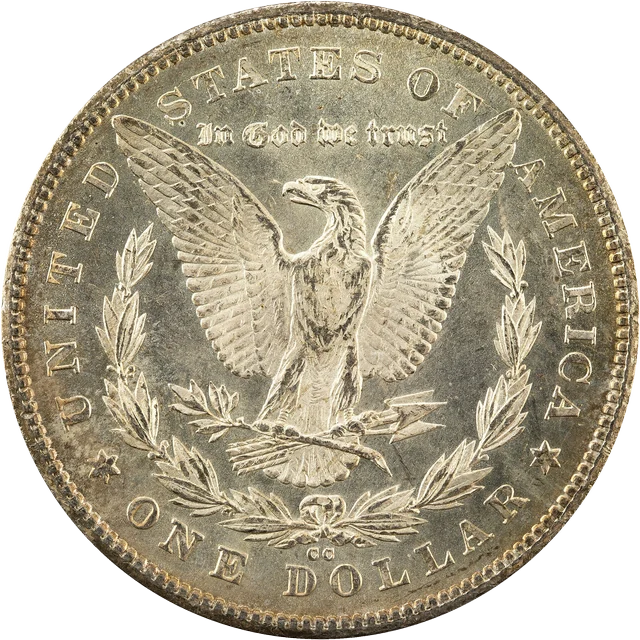
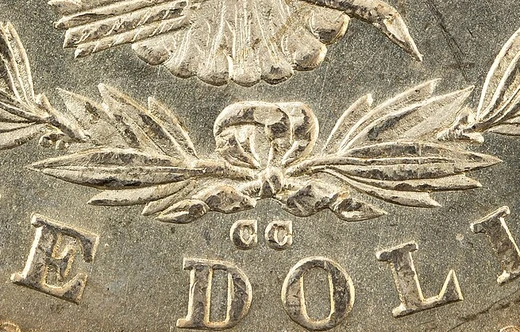
- Confirm the space above the DO in DOLLAR is empty. The 1899-O and 1899-S are far more common, and only the no-letter coin carries the worn-grade premium.
- Look at the edge: Bowers notes Philadelphia dollars of this era have a broader edge with rounded corners and reeding only across the center, while branch-mint edges have sharp corners. The difference fades on heavily worn coins.
- Expect strike quality to vary from weak and dull to sharp and frosty on this date. A soft strike is a reason to shop for a better coin, not proof of a fake.
Sources: 1899 $1 (Regular Strike), PCGS CoinFacts; 1899 Morgan dollar listing, Silver Dollars & Trade Dollars of the United States (Bowers), PCGS; 1900 Morgan dollar listing, Silver Dollars & Trade Dollars of the United States (Bowers), PCGS.