 CoinYearValue
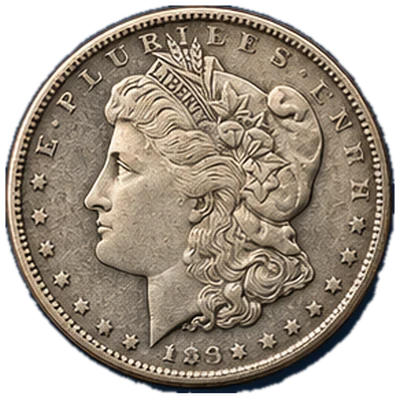
A dollar made by silver politics and saved in Treasury vaults
The Coinage Act of 1873 had dropped the standard silver dollar. Five years later the Bland-Allison Act of 1878 restored it, requiring the Treasury to buy large amounts of silver bullion and coin it into dollars, and George T. Morgan's design was used from the start. His Liberty grew out of earlier pattern work and is reportedly modeled on Anna Willess Williams. Because the law set the output rather than public demand, far more dollars were struck than anyone needed for commerce, and huge numbers went straight into vault storage.
Five mints struck them: Philadelphia, New Orleans, San Francisco, Carson City, and, in 1921 only, Denver. Production paused after the bullion bought under these laws ran out around 1904. In 1918 the Pittman Act sent 270,232,722 stored dollars to the melting pot, and the 1921 revival of roughly 87 million coins was a stopgap to replace them until the Peace dollar was ready late that year.
The keys are mostly dates the Treasury paid out or melted rather than ones with tiny mintages. The 1893-S had 100,000 struck and the 1889-CC 350,000; for both, the usual fake is a Philadelphia coin with a mint mark added. NGC ranks the 1893-S tenth and the 1889-CC 43rd on its list of the most counterfeited U.S. coins, which covers gold as well as silver. The 1895 Philadelphia dollar is known only as a proof. CoinWeek's list of expensive dates also takes in the 1879-CC, 1883-S, 1884-S, 1886-O, 1892-S, 1893-CC and 1895-S. The 1895-O is the classic condition rarity: common enough in low grades, very rare in high ones.
The vault hoards are why so many Morgans survive in mint state. Bags were paid out through banks for much of the 20th century, and casinos fed silver dollars into slot machines until silver rose above face value. In the 1970s, the Redfield hoard put hundreds of bags on the market, mostly San Francisco coins. Millions of Carson City dollars that had never circulated turned up in Treasury vaults and were sold through General Services Administration mail-bid sales in the 1970s and 1980s, and the Continental-Illinois Bank hoard followed with even higher quality. CoinWeek credits those government sales with fueling much of modern Morgan collecting.
Van Allen and Mallis's 1971 book gave every die variety a VAM number, and variety collecting took off from there. The best-known include the 1878 with eight tail feathers, the 1878 seven-over-eight feathers, the 1888-O Hot Lips doubled die, the 1899-O Micro O, and the 1903-S Micro S. At the top of the series sit the 1921 Chapman and Zerbe proofs. Collectors also build high-grade date sets and complete sets across grades, which the surviving bag coins make possible for most dates.
What to check on this one
- On an 1893-S or 1889-CC, examine the mint mark under the wreath for signs it was added; NGC lists both among the most counterfeited U.S. coins.
- An 1895 dollar with no mint mark and circulation wear is almost certainly fake or altered, because Philadelphia made 1895 dollars only as proofs.
- On 1878 Philadelphia dollars, count the eagle's tail feathers: eight, seven, or seven struck over eight are three different varieties.
- A D mint mark belongs only on a 1921 Morgan, the one year Denver struck them; a D on any other date means the coin was altered.
Sources: Morgan Dollar (1878-1921) (CoinWeek); Morgan Dollar (1878-1921) category (PCGS CoinFacts); Top 50 Most Commonly Counterfeited U.S. Coins (NGC); Peace Dollar (1921-1935) category (PCGS CoinFacts); Pittman Act.