Certified MS65$31Near flawless, graded by PCGS or NGC
Values for the 1942-P (silver) nickel. Other mint marks are in the table below.
A worn 1942-P (silver) nickel is worth about $2.66, the value of the silver in it.
Uncirculated, that coin brings $6–14, and a certified MS65 brings $31. In worn condition, the 1942-D (regular alloy) is worth the most: about 55¢–$5.
A worn 1942-P is worth its silver: a coin dealer or bullion buyer will pay close to melt value. Uncirculated coins bring more; see the table. Check the mint mark before you sell.
Advertisement
Two alloys, one date: the 1942 switch to wartime silver
Congress passed the law on March 27, 1942 that let the Treasury take nickel out of the five-cent piece. The first plan was half silver and half copper, but that mix failed in vending machines and turnstiles, which checked a coin's weight and magnetic response. Adding 9% manganese fixed it. Philadelphia and Denver kept striking the old copper-nickel coin for most of the year, and that work wrapped up several months before the new metal arrived. Most numismatic references give October 8, 1942 as the day circulation coinage in the wartime alloy began.
Only Philadelphia and San Francisco struck the silver version in 1942, which is why the large mint mark above the dome on a 1942 coin can only be a P or an S. Denver made none. Its regular-alloy 1942-D run of 13,938,000 is the smallest Denver nickel mintage in this decade, and it carries the year's best variety. A worker punched the D into one working die sideways, then punched it again upright. The resulting D over horizontal D is strong enough to see with the naked eye, and Jaime Hernandez of PCGS CoinFacts thinks fewer than 100 exist in uncirculated grades.
Proofs were made in both compositions in 1942, the last proof nickels sold to the public until 1950. A Philadelphia collector can therefore find a 1942 nickel in two metals: one with no mint mark and one with a big P, the first time Philadelphia's letter ever appeared on a U.S. coin.
What to check on this one
Flip the coin: no mint mark or a small D beside Monticello means copper-nickel; a large P or S over the dome means 35% silver.
On a 1942-D, look at the D with a loupe for the curved edge of a sideways D running through it.
A 1942-P or 1942-S in an old album may have toned deep gold, gray or nearly black; that is normal for the silver alloy and not damage.
What each 1942 nickel is worth, by grade and mint mark
Grade
No mark
D
P silver
S silver
GoodGoodG4Heavily worn; date and letters still readable
5¢
55¢
$2.66
$2.66
FineFineF12Worn, but all the main lettering is clear
5¢
$1
$2.66
$2.66
Very FineV. FineVF20Light to moderate wear on the high spots
7¢
$5
$2.66
$2.66
Extremely FineEx. FineEF40Light wear on the highest spots only
10¢
$5
$2.66
$2.66
About UncirculatedAbout Unc.AU50Traces of wear, some original shine
80¢
$11
$3.66
$3.66
UncirculatedUnc.MS60No wear, but plenty of marks
$7
$22
$6
$6
Choice UncirculatedChoice Unc.MS63No wear and only a few marks
$14
$35
$14
$14
Gem UncirculatedGem Unc.MS65Certified and nearly flawless
$30
$55
$31
$32
Good through About Uncirculated are for coins as found, not in a grading holder. MS60 and MS63 are uncirculated coins; MS65 is a coin certified by PCGS or NGC. Wartime nickels, made from late 1942, are 35% silver and have a large mint mark above Monticello, including a P for Philadelphia. Their columns follow the live silver price. No value drops below the silver in the coin, and those cells follow the live silver price. Values checked November 15, 2026 against public price guides and auction records. How values work.
What a 1942 nickel looks like
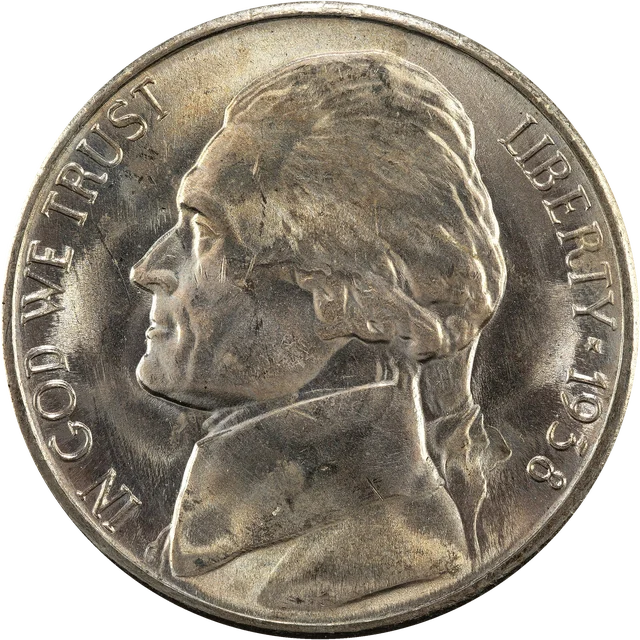
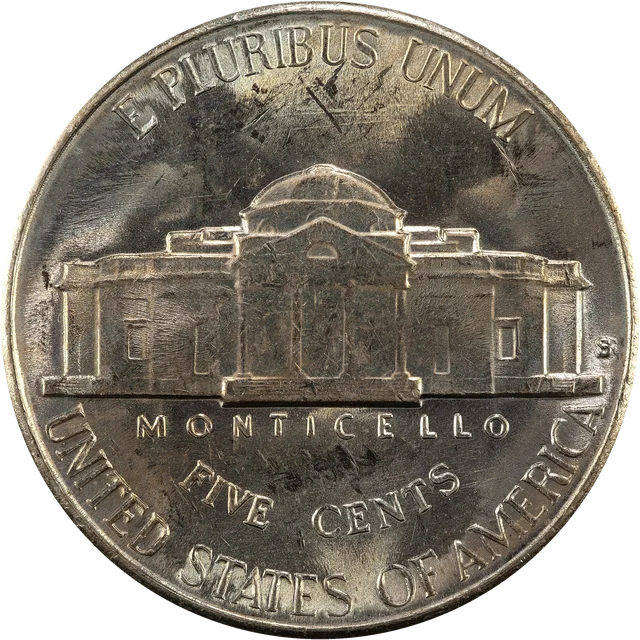
FrontBack
Shown: a 1938 Jefferson nickel, the same design. Photos: National Numismatic Collection, National Museum of American History (photo by Jaclyn Nash), Public domain, via Wikimedia Commons.
Varieties and errors to check
Two kinds of 1942 nickel
Look for: A large P or S above Monticello means 35% silver. No mark, or a small D to the right of Monticello, means regular nickel alloy.
Look for: Look at the D mint mark to the right of Monticello on the back (this is a regular copper-nickel 1942-D, not a wartime silver nickel). The outline of a D punched sideways shows under the upright D; on most examples it can be seen without magnification.
A Denver die was first punched with a D lying on its side, then corrected with an upright D, and the sideways D stayed visible.
Regular coins: Back of the coin, to the right of Monticello. Philadelphia coins have no letter.
Silver wartime coins: Back of the coin, a large letter above Monticello's dome. 1942 silver nickels have P or S; 1943–1945 have P, D or S. This is the only time Philadelphia put a P on a coin before 1979.
What it's made of
75% copper, 25% nickel, 5.0 grams
Wartime alloy: 56% copper, 35% silver, 9% manganese, 5.0 grams, 0.05626 troy oz of silver, worth $2.66 today
Melting cents and nickels is not allowed under U.S. Mint rules, so copper and nickel value is a guide only.
Condition matters
Collectors pay extra when the steps of Monticello on the back are sharply struck (called Full Steps).
Mintage
How many were made
Coin
Type
Mintage
1942-D (regular alloy)
For circulation
13,938,000
1942 (regular alloy)
For circulation
49,789,000
1942-P (silver)
For circulation
57,873,000
1942-S (silver)
For circulation
32,900,000
Questions
Is a 1942 nickel silver?
Some are. 1942 nickels with a large P or S above Monticello on the back are 35% silver. Those with no mint mark, or a small D to the right of Monticello, are regular nickel alloy.
Which 1942 nickel is worth the most?
In MS65, the 1942-D (regular alloy) is worth the most, about $55. The 1942-D, D over horizontal D nickel (FS-501) is the one to look for: typical examples sell for $50–3,100.
Where is the mint mark on a 1942 nickel?
Regular coins: Back of the coin, to the right of Monticello. Philadelphia coins have no letter. Silver wartime coins: Back of the coin, a large letter above Monticello's dome. 1942 silver nickels have P or S; 1943–1945 have P, D or S. This is the only time Philadelphia put a P on a coin before 1979.
As an Amazon Associate I earn from qualifying purchases. As an eBay Partner Network affiliate, we may also earn a commission when you buy through links on this site, at no extra cost to you. Affiliate disclosure.
 CoinYearValue