Certified MS65$22–28Near flawless, graded by PCGS or NGC
A worn 1943 nickel is worth about $2.66, the value of the silver in it.
Uncirculated ones bring $3.66–12, and a certified MS65 brings $22–28, depending on the mint mark.
A worn one is worth its silver: a coin dealer or bullion buyer will pay close to melt value. Uncirculated coins bring more; see the table.
Advertisement
Record wartime output and the 1943/2 overdate
Philadelphia's 271,165,000 nickels in 1943 are the largest mintage of the whole silver war series, and no U.S. mint struck more five-cent pieces in a single year until Denver passed it in 1962. With all three mints running the wartime alloy for the first full year, the overdate is the coin people hunt. Dies for the coming year were normally prepared in the fall, and at least one Philadelphia die got a 1943 date over an earlier 1942 impression from mismatched hubs. CoinWeek puts the number struck from it at roughly 100,000 to 200,000, with only a couple of hundred known in mint state.
The other famous 1943-P comes from hub impressions that did not line up, leaving Jefferson with what looks like a second eye. On Philadelphia coins only about 1 in 5 shows 5 of the 6 steps on Monticello, and coins with all 6 are scarce. Denver was a different story. The 1943-D, with just 15,294,000 made, is the lowest mintage of the year, yet PCGS rates its quality as excellent and had graded 137 at MS67 without Full Steps by 2012. PCGS has seen more Full Steps 1943-D nickels than coins without them.
A handful of 1943 nickels were struck by mistake on leftover copper-nickel planchets from before the war. NGC notes the wartime metal was poorly mixed, so planchet laminations, where a thin flake of metal peels from the surface, turn up more often than on prewar nickels.
What to check on this one
Under magnification, look at the 3 in the date for the curve of a 2 inside its lower half (1943/2-P).
Look at Jefferson's eye on a 1943-P; a second eyelid outline just beside it is the doubled eye variety.
A leftover copper-nickel planchet looks much like the silver alloy, so a 1943 nickel with the large mint mark that tests as non-silver should go to PCGS or NGC as a possible wrong-metal error.
Check the surfaces for peeling or flaking; a lamination can be an error collectors want or a reason a coin won't grade.
What each 1943 nickel is worth, by grade and mint mark
Grade
P
D
S
GoodGoodG4Heavily worn; date and letters still readable
$2.66
$2.66
$2.66
FineFineF12Worn, but all the main lettering is clear
$2.66
$2.66
$2.66
Very FineV. FineVF20Light to moderate wear on the high spots
$2.66
$2.66
$2.66
Extremely FineEx. FineEF40Light wear on the highest spots only
$2.66
$2.66
$2.66
About UncirculatedAbout Unc.AU50Traces of wear, some original shine
$3.16
$3.41
$3.66
UncirculatedUnc.MS60No wear, but plenty of marks
$3.66
$4.16
$5.16
Choice UncirculatedChoice Unc.MS63No wear and only a few marks
$9
$10
$12
Gem UncirculatedGem Unc.MS65Certified and nearly flawless
$23
$22
$28
Good through About Uncirculated are for coins as found, not in a grading holder. MS60 and MS63 are uncirculated coins; MS65 is a coin certified by PCGS or NGC. No value drops below the silver in the coin, and those cells follow the live silver price. Values checked November 15, 2026 against public price guides and auction records. How values work.
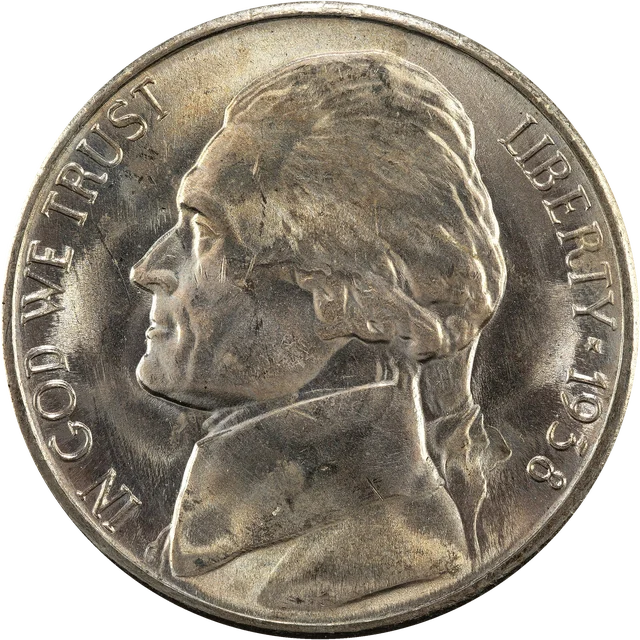
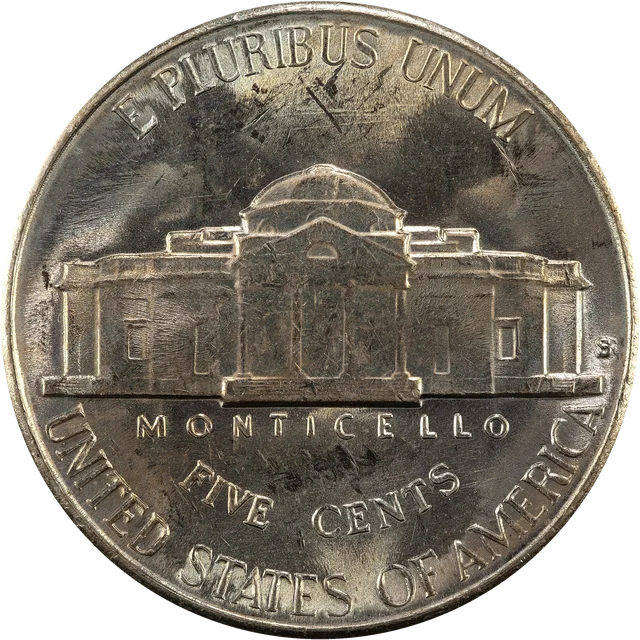
What a 1943 nickel looks like
FrontBack
Shown: a 1938 Jefferson nickel, the same design. Photos: National Numismatic Collection, National Museum of American History (photo by Jaclyn Nash), Public domain, via Wikimedia Commons.
Varieties and errors to check
1943/2-P overdate nickel (FS-101)
Look for: Use a 10x loupe on the 3 in the date: part of a 2 shows at the bottom of the 3, inside its lower curve. This is a 35% silver wartime nickel with a large P above Monticello's dome on the back. Light doubling also shows on IN GOD WE TRUST and LIBERTY.
The working die was impressed first with a 1942 hub and then a 1943 hub, so it is both an overdate and a doubled die.
Look for: Look at Jefferson's eye: a second outline makes it look like two overlapping eyes. A 5x loupe also shows doubling on LIBERTY, the date and IN GOD WE TRUST. Large P mint mark above Monticello's dome on the back.
A doubled die obverse from a hub and die that were out of alignment. It is the best-known obverse doubled die in the Jefferson series.
Back of the coin, a large letter above Monticello's dome. 1942 silver nickels have P or S; 1943–1945 have P, D or S. This is the only time Philadelphia put a P on a coin before 1979.
What it's made of
Wartime alloy: 56% copper, 35% silver, 9% manganese, 5.0 grams, 0.05626 troy oz of silver, worth $2.66 today
Melting cents and nickels is not allowed under U.S. Mint rules, so copper and nickel value is a guide only.
Condition matters
Collectors pay extra when the steps of Monticello on the back are sharply struck (called Full Steps).
Mintage
How many were made
Coin
Type
Mintage
1943-D
For circulation
15,294,000
1943-P
For circulation
271,165,000
1943-S
For circulation
104,060,000
Questions
Is a 1943 nickel silver?
Yes. Every 1943 nickel made for circulation contains 0.05626 troy ounces of silver. Its silver value moves with the silver price; the live figure is shown at the top of this page.
Which 1943 nickel is worth the most?
In MS65, the 1943-S is worth the most, about $28. The 1943/2-P overdate nickel (FS-101) is the one to look for: typical examples sell for $35–490.
Where is the mint mark on a 1943 nickel?
Back of the coin, a large letter above Monticello's dome. 1942 silver nickels have P or S; 1943–1945 have P, D or S. This is the only time Philadelphia put a P on a coin before 1979.
As an Amazon Associate I earn from qualifying purchases. As an eBay Partner Network affiliate, we may also earn a commission when you buy through links on this site, at no extra cost to you. Affiliate disclosure.
 CoinYearValue