 CoinYearValue
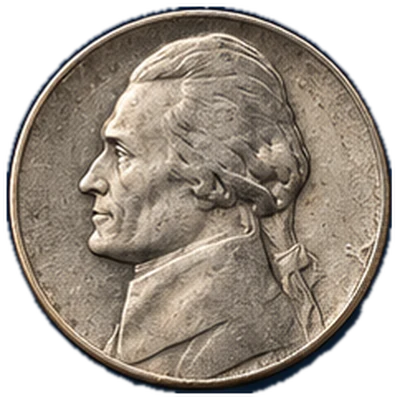
Schlag's contest win, the silver war nickels and two Denver keys
When the Buffalo nickel's 25 years were up, the Mint announced an open design contest in January 1938. Felix Schlag won the $1,000 prize, but the Commission of Fine Arts sent his Monticello back for changes: it wanted a straight-on view of the building in place of his angled one, plus new lettering. Schlag finished the revisions in July 1938. Production began at all three mints on October 3, and the coins were released on November 15. Some critics at the time felt a building had no place on national coinage, and Schlag himself got no signature on the coin until his FS was added below the bust in 1966.
Wartime metal is the part of the series most people ask about. An act of March 27, 1942 authorized a five-cent coin with no nickel in it, officially to save it for armor plate, though numismatist David Lange argues the savings were tiny and the change was mostly a public show of sacrifice. A half copper, half silver mix was tried first, but it failed the slug-rejection tests used in vending machines and turnstiles, so manganese was added to bring back the right electrical signature. The new alloy went into production in October 1942. Its mint marks were made large and moved above the dome so the coins could be pulled out of circulation after the war, and Philadelphia's P was the first time that mint marked a U.S. coin. Denver struck only the regular alloy in 1942, so there is no silver 1942-D.
The two key dates both come from Denver. The 1939-D had 3,514,000 struck and the 1950-D 2,630,030, yet the 1939-D is the harder coin, because few were set aside in new condition. The 1950-D was hoarded by the roll during the 1950s and early 1960s roll boom, when an uncirculated roll reportedly brought as much as $1,000, so today a mint-state 1950-D is easier to find than a well-worn one. The 1939-D also comes with two reverse hubs, called the Reverse of 1938 and the Reverse of 1940, which differ in how sharply the steps of Monticello are cut.
Variety collectors chase the 1939 doubled Monticello reverse, the 1942-D with a D punched over a horizontal D, the 1943-P doubled die obverse, the 1945-P doubled die reverse, and a run of over-mintmarks: 1949-D/S, 1954-S/D and 1955-D/S. Strike quality matters too. Graders note coins with five or six complete steps under Monticello as Full Steps, and those carry the premium in high grades.
Production climbed to a record 1,787,297,160 nickels at Denver in 1964. Mint marks were dropped from 1965 to 1967, moved to the obverse in 1968, and Philadelphia began adding a P in 1980. The Lewis and Clark bicentennial brought reverse changes in 2004 and 2005.
What to check on this one
- An oversized mint letter sitting over the dome marks a 35% silver war nickel; a 1942 with a small letter beside the building, or none, is the normal alloy.
- On a 1939 nickel, look for doubled letters on the reverse, especially MONTICELLO; that is the 1939 doubled die reverse.
- Count the steps at Monticello's base with a loupe. Five or six unbroken steps is what Full Steps means, and it matters most on 1939-D and other early Denver dates.
- A 1942-D with the D lying on its side under an upright D is the 1942-D over horizontal D variety.
Sources: Jefferson Nickel, 1938-2003: History and Value (CoinWeek); The Wartime Silver 'Nickels' of 1942-45, Part One (NGC, David W. Lange); The Affordable Yet Scarce 1939-D & 1950-D Jefferson Nickel Key Dates (PCGS); Building the Ultimate 20th-Century Type Set, Part 2: Nickels and Dimes (CoinWeek); The Top 50 U.S. Coins of All Time (PCGS); Jefferson nickel (Wikipedia).