 CoinYearValue
Junk silver: how to price it, buy it and sell it
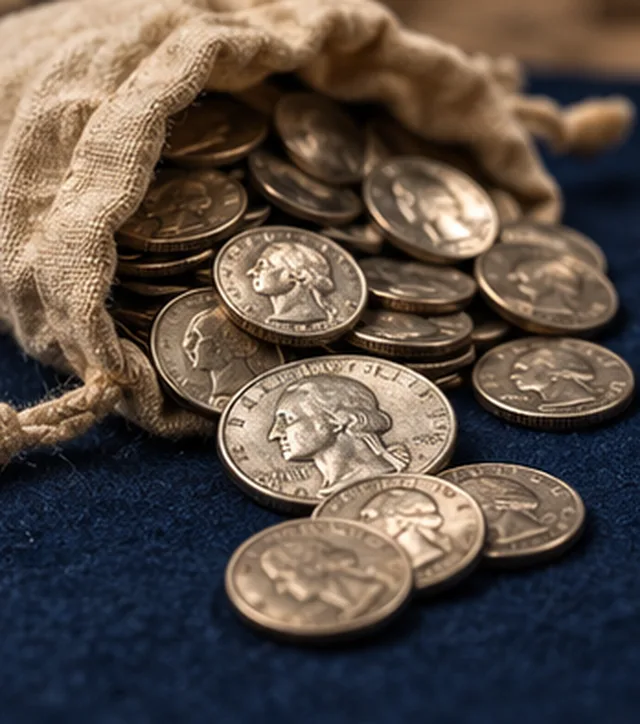
Junk silver is the trade name for worn U.S. coins bought and sold for their silver, not their collector value. Dealers price it by face value: a bag marked $100 face holds $100 worth of dimes, quarters or halves, whatever the dates. Because every 90% silver dime, quarter and half dollar holds silver in exact proportion to its face value, a dollar of face in dimes contains the same silver as a dollar of face in halves.
That makes the math easy once you know two numbers, the ounces per dollar of face and the day's silver price.
Which coins count
| Coins | Silver | Silver per coin | Silver per $1 face |
|---|---|---|---|
| Dimes, quarters and halves dated 1964 and earlier | 90% | Dime 0.0723 oz, quarter 0.1808 oz, half 0.3617 oz | 0.7234 oz (new) |
| Kennedy halves, 1965 to 1970 | 40% | 0.1479 oz | 0.2958 oz |
| Wartime Jefferson nickels, 1942 to 1945 | 35% | 0.0563 oz | 1.1252 oz |
The 1964 cutoff comes from the Coinage Act of 1965, which moved dimes and quarters to copper-nickel clad. The half dollar dropped to 40% silver and stayed there through 1970. A 1965 quarter is clad and worth face value, unless it is one of the rare errors struck on a leftover silver blank.
Wartime nickels are easy to miss. Only the ones with a large mint mark letter above Monticello on the back are silver; our 1942 nickel page explains the two kinds struck that year. Per dollar of face, war nickels hold more silver than any other U.S. coin, since 20 of them add up to $1.
Bicentennial quarters and halves with an S mint mark from collector sets are also 40% silver, but they are sold as collector coins, not by face. See the 1976 quarter page.
Face value math: why dealers use 0.715
A full-weight dollar of 90% coins holds 0.7234 troy ounces of silver. Circulated coins have lost a little metal to wear, so the common factor for mixed circulated coins is 0.715 ounces per $1 face, about 1% less. That works out to about 715 ounces in a $1,000 face bag.
The formula:
- 90%: face value × 0.715 × silver price
- 40% halves: face value × 0.2958 × silver price (two halves per dollar)
- War nickels: number of nickels × 0.0563 × silver price
Coinflation listed silver at $57.45 an ounce on October 18, 2026. At that price:
| Amount | Silver | Melt |
|---|---|---|
| $1 face, 90%, circulated | 0.715 oz | $41.08 |
| $10 face, 90% (one roll of halves) | 7.15 oz | $410.77 |
| $100 face, 90% | 71.5 oz | $4,107.68 |
| $1 face, 40% halves | 0.2958 oz | $16.99 |
| One war nickel | 0.0563 oz | $3.23 |
Silver moves every minute, so plug today's price into the melt value calculator rather than relying on these figures. Our year pages, such as the 1964 quarter and 1964 half dollar, update with the live price too.
Premiums and dealer spreads, as checked in October 2026
Dealers sell junk silver above melt and buy it below. The gap between the two is the spread, and it is what you pay for a round trip. We checked APMEX's listings for 90% coins in October 2026, when that page showed silver at $61.10.
| Product | Price | Per $1 face |
|---|---|---|
| $1 face, mixed, average circulated | $47.26 | $47.26 |
| $10 face roll, mixed | $443.94 | $44.39 |
| $100 face bag, mixed | $4,439.44 | $44.39 |
| $1,000 face bag, mixed | $44,394.35 | $44.39 |
| $1 face Barber dimes | $58.69 | $58.69 |
| $10 face culls | $434.70 | $43.47 |
Three things show up in those numbers. Buying a single dollar of face cost about 6.5% more per dollar than buying a roll or a bag. Older designs carry their own premium: Barber dimes cost about 24% more per dollar of face than mixed coins. And the worst-looking coins (culls) were the cheapest per ounce on the page.
The buy side is harder to check. APMEX does not post a public price for buying junk silver back; it quotes by phone or online request at market-based pricing. Get two or three written offers per dollar of face before you sell, and ask whether the quote is per $1 face or per ounce so you can compare them.
Buying safely
- Compare price per dollar of face. Divide the price by the face value. Then divide by 0.715 to get the price per ounce and compare it with spot.
- Weigh a sample. A 90% dime weighs 2.5 grams, a quarter 6.25 grams and a half 12.5 grams. A clad quarter weighs 5.67 grams, so a clad coin slipped into a roll stands out on a cheap scale. A 40% Kennedy half weighs 11.5 grams.
- Look at the edges. Silver coins have a solid silver-colored edge. A copper stripe means clad. Our silver test guide walks through this.
- Don't pay collector prices for junk. A worn 1964 quarter is worth its silver, and a dealer or bullion buyer pays close to melt for it. Pay more only for uncirculated coins or a known key date.
- Check before you sell as bullion. Look up any older or unusual date on its year page first, since a scarce date or mint mark is worth more than melt.
Selling junk silver
Local coin shops, bullion dealers and online buyers all buy junk silver. Sort first: separate 90% from 40% and pull out war nickels, because each is priced differently. Count the face value of each group. Then call with the totals and the day's spot price in hand, so you can check the offer against melt.
Convert every offer to a price per $1 face before choosing. Keep the dealer's receipt; you need it at tax time. The where to sell old coins guide compares shops, shows and online buyers, and the inherited collection guide covers sorting a large accumulation.
Taxes and reporting basics
The IRS treats coins as collectibles. Net capital gains from selling collectibles are taxed at a maximum rate of 28%. Coins held more than one year produce long-term gain or loss. Coins held one year or less produce short-term gain, taxed as ordinary income.
Your gain is the sale price minus your basis, which is generally what you paid. Inherited coins follow different basis rules covered in IRS Publication 551. Sales are reported on Form 8949 and carried to Schedule D. Net capital losses that exceed your gains can offset only $3,000 of other income a year ($1,500 if married filing separately).
Form 1099-B. Dealers do not file a 1099-B for most coin sales. Under the IRS instructions for Form 1099-B, a precious metal sale is reportable only if that form of the metal is approved for trading under a CFTC regulated futures contract and the sale meets the contract's minimum quantity. The IRS gives the example of a single gold coin: no report is needed, because the approved gold coin contracts call for delivery of at least 25 coins. A dealer must add together one customer's sales within 24 hours, and the exemption does not apply if the dealer has reason to think a customer is splitting sales to avoid reporting. A missing 1099-B does not make a gain tax-free; you still report it.
This is general information, not tax advice. A tax preparer can tell you how it applies to your situation.
Supplies mentioned in this guide
As an Amazon Associate I earn from qualifying purchases. These are paid links. Affiliate disclosure.
Questions
How much silver is in $1 face value of junk silver?
About 0.715 troy ounces for circulated 90% coins. New, unworn coins hold 0.7234 ounces. Two 40% Kennedy halves hold 0.2958 ounces.
Are 1965 to 1970 half dollars junk silver?
Yes, but they are 40% silver and trade separately from 90% coins, at well under half the silver per dollar of face.
Do I pay tax when I sell junk silver?
If you sell for more than you paid, yes. The IRS treats coins as collectibles, with long-term gains taxed at up to 28%.
Will the dealer send me a 1099-B?
Usually not. Reporting applies only to forms and quantities that meet a CFTC-approved futures contract. You owe tax on a gain either way.
Sources
Checked October 19, 2026. See our editorial policy for how we source facts.