 CoinYearValue
Inherited a coin collection: what to do first
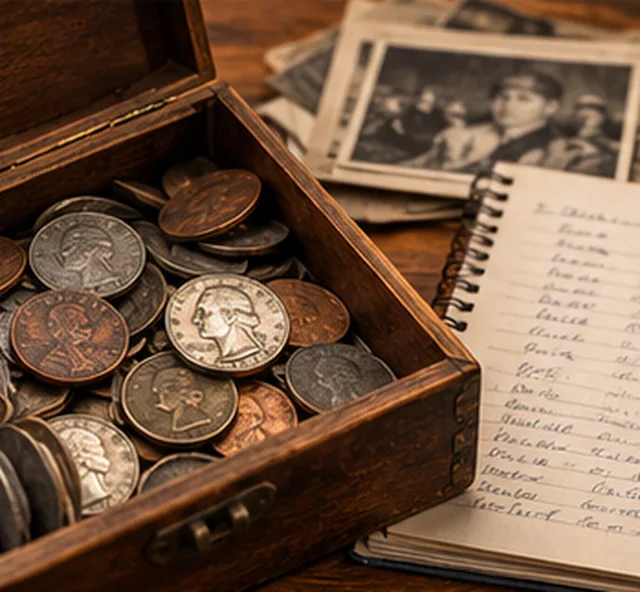
The most expensive mistakes with an inherited collection happen in the first week: someone scrubs the coins to make them look nice, or a buyer offers one round number for the whole box before anyone has looked inside. Neither can be undone. Coin World's Readers Ask column once handled a family with a homemade tube of 115 old dimes. Nothing in it was scarce, so the coins were worth their silver, but a single 1916-D Mercury dime in a tube like that is a coin worth thousands.
Most inherited collections are a mix of coins worth face value, coins worth their metal, and a few worth a collector premium. The job is to find out which is which before money changes hands.
Step 1: Don't clean anything, and don't sell yet
Leave every coin exactly as you found it. Cleaning removes original surface, and grading services label cleaned coins with a Details grade that cuts their price, sometimes by more than half. A cleaned 1878-CC $20 gold piece sold for $4,800 in 2019 when an uncleaned one in similar condition brought $12,600. Our guide on cleaning old coins has more examples.
Keep coins in whatever holders, albums or envelopes they came in, since those often record what the collector knew: dates, grades, prices paid. If the coins are in soft, flexible plastic flips, which can leave green residue on silver over time, note which ones and plan to move them into inert holders soon.
Step 2: Sort by metal
The quickest first pass is by denomination and date, because the date tells you the metal for most U.S. coins. Check the edge, too: a copper stripe means clad.
| Coins | Metal | Silver per coin |
|---|---|---|
| Dimes, 1964 and earlier | 90% silver | 0.07234 oz |
| Quarters, 1964 and earlier | 90% silver | 0.18084 oz |
| Half dollars, 1964 and earlier | 90% silver | 0.36169 oz |
| Kennedy halves, 1965 to 1970 | 40% silver | Less than half the 1964 amount |
| Morgan and Peace dollars | 90% silver | 0.77344 oz |
| Nickels, 1942 to 1945, large mint mark above Monticello | 35% silver | 0.05626 oz |
| Dimes, quarters and halves from 1965 (halves from 1971) | Copper-nickel clad | None |
Bag the piles separately: gold, 90% silver, 40% silver, war nickels, wheat cents, and everything else. If you are unsure about a coin, the silver testing guide covers the weight and edge checks. A 1964 quarter is silver; a 1965 quarter is not.
Step 3: Identify dates and mint marks
Within each pile, read the date and the mint mark on every coin. The mint mark is the small letter (D, S, O, CC and others) that tells you where it was struck, and it often matters more than the date. A 1909 VDB cent with no mint mark sells for about $8 to $20 worn, while the 1909-S VDB brings about $800 to $1,400 in the same condition. Our mint marks guide shows where the letter sits on each series.
Look up each date and mint on its year page or in a printed guide such as the Red Book. Set aside anything that is a key date, carries a CC mark, looks uncirculated, is gold, or is already sealed in a PCGS or NGC holder.
Step 4: Separate bullion from numismatic coins
Coins fall into two groups that sell in different ways.
- Bullion-value coins are common dates whose price tracks metal: worn 90% silver dimes, quarters and halves, common Morgan dollars, war nickels, and modern bullion coins. A dealer will usually offer the silver spot price minus a small percentage, since they plan to resell at a small profit. Sell these by weight, using our melt value calculator to check the figure. Our page on junk silver covers how that market prices it.
- Numismatic coins are worth more than their metal because of rarity or condition: key dates, scarce mint marks, high-grade or certified coins, proof sets with unusual pieces, and error coins. These need individual pricing, and selling them by weight is the classic way heirs lose money.
Step 5: Make an inventory
Write down each coin, or each group of identical common coins, with denomination, series, date, mint mark, metal, rough condition, and any holder or certification number. Note purchase receipts if the collector kept them. Coin World recommends this level of detail for any collection that will be valued. A spreadsheet works. Photograph the better coins front and back.
The inventory does three jobs. It lets several people value the same list, it records what was in the estate on the date of death for tax purposes, and it makes it obvious if a coin goes missing after someone has handled the collection.
Step 6: Get it valued, and know what each option costs
| Option | Cost | What you get |
|---|---|---|
| Price guides (Red Book, Coin World values, this site) | Free online, or the price of a book | Retail estimates; you supply the grade |
| Wholesale guide (Grey Sheet) | Paid publication | What dealers pay each other |
| Dealer "free appraisal" | Free | An offer from someone who wants to buy |
| Independent appraiser | Usually an hourly fee | A written value from someone with no stake in buying |
| PCGS or NGC grading | Tiered per-coin fees by value and speed | Authentication and a grade that buyers trust |
| Selling on eBay | 13.25% of the sale up to $7,500 for coins (13.6% for bullion), plus a $0.30 to $0.40 order fee | A market price, minus your time |
Coin World notes that many dealers will appraise for free if they expect a chance to buy, while appraisers who do not buy charge a fee, usually hourly, and inspect in person. The American Society of Appraisers lists members who specialize in coins. For estate paperwork, a written appraisal from someone who is not bidding carries more weight. Grading pays only for coins where a certified grade changes the price by more than the fee, so send the few best coins, not the whole box. See our grading guide for how that decision works.
Appraisal versus offer
An appraisal is an opinion of value, usually retail or fair market value, from someone paid a fee. What one buyer will pay today is an offer, and it will be below retail because the dealer has to resell. Both are useful. Problems start when an offer is presented as an appraisal. If the person valuing the coins also wants to buy them, treat the number as an offer and get others.
Estate and tax basics
This is general information from IRS publications; ask a tax professional about your situation.
- Your basis is the value at death. Under IRS Publication 551, inherited property generally takes as its basis its fair market value on the date of death, or on the alternate valuation date if the estate's representative elects it. If the estate filed an estate tax return and you received a Schedule A (Form 8971), you must use a basis consistent with that reported value. Gains are measured from that figure, not from what the collector paid decades ago.
- It counts as long-term. Publication 544 says inherited property is treated as held more than one year, however soon you sell.
- Coins are collectibles. The IRS lists coins and gold and silver bullion as collectibles, and net long-term gains on collectibles are taxed at a maximum 28% rate rather than the 0%, 15% or 20% rates for most capital gains. Sales go on Form 8949 and Schedule D.
- Federal estate tax rarely applies. A federal estate tax return is required only when the gross estate plus adjusted taxable gifts exceeds $15,000,000 for deaths in 2026 ($13,990,000 in 2025).
Because the basis is set by date-of-death value, a dated inventory and appraisal from around that time is the best record you can keep. Selling soon after the death at close to that value usually means little or no taxable gain.
How to avoid a lowball offer
- Do the sort and inventory before anyone makes an offer. A buyer who sees an unsorted box prices it as an unsorted box.
- Know the melt value of the silver and gold piles yourself, so the floor is not a mystery.
- Get at least two or three written, itemized offers. Itemized means you can see which coins the buyer valued and which they dismissed.
- Sell the bullion and the better coins separately. One lump price usually pays bullion rates for everything.
- Favor dealers who belong to the Professional Numismatists Guild. Members must have at least three years as professional numismatists, agree to binding arbitration of disputes, and pledge to pay reasonable prices and not misrepresent value. The PNG website has a member directory.
- Never let the coins leave your sight for an "evaluation," and do not accept pressure to decide on the spot.
When you have the list and the offers, the selling guide compares dealers, auctions and online selling.
Supplies mentioned in this guide
As an Amazon Associate I earn from qualifying purchases. These are paid links. Affiliate disclosure.
Questions
Should I clean inherited coins before selling them?
No. Cleaning lowers value and graders and dealers can see it. Sell them as found.
How do I know if a coin collection is worth anything?
Sort by date first. Dimes, quarters and halves dated 1964 or earlier are 90% silver and always worth more than face. Then check dates and mint marks for key coins, and look closely at any gold or coins already in grading holders.
Do I pay taxes when I sell inherited coins?
Only on gain above the coin's fair market value at the date of death, which is your basis. The gain is long-term automatically, and collectible gains are taxed at up to 28% federally.
Is a free appraisal from a coin dealer reliable?
It can be fair, but it is really an offer from someone who hopes to buy. Get several, or pay an independent appraiser who will not bid.
Should I get every coin graded?
No. Grading has a per-coin fee, so it only makes sense for coins where a certified grade adds more than the cost, usually key dates, gold, and high-grade pieces.
Sources
- Handling inherited coins (Coin World, Readers Ask, Jul 2011)
- Sight unseen coin appraisal? (Coin World, Readers Ask, Oct 2011)
- 'Harshly Cleaned' 1878-CC gold $20 means opportunity (Coin World, Jun 2019)
- PVC in online coin auctions (Coin World blog)
- Publication 551, Basis of Assets (IRS)
- Publication 544, Sales and Other Dispositions of Assets (IRS)
- Topic no. 409, Capital gains and losses (IRS)
- Instructions for Schedule D (Form 1040) (IRS)
- Estate tax (IRS)
- Selling fees (eBay), checked October 2026
- PNG membership categories and applications (Professional Numismatists Guild)
- Collector's Bill of Rights (Professional Numismatists Guild)
- Coin collecting (Wikipedia)
- Kennedy half dollar (Wikipedia)
- Jefferson nickel (Wikipedia)
Checked October 19, 2026. See our editorial policy for how we source facts.