CoinYearValue
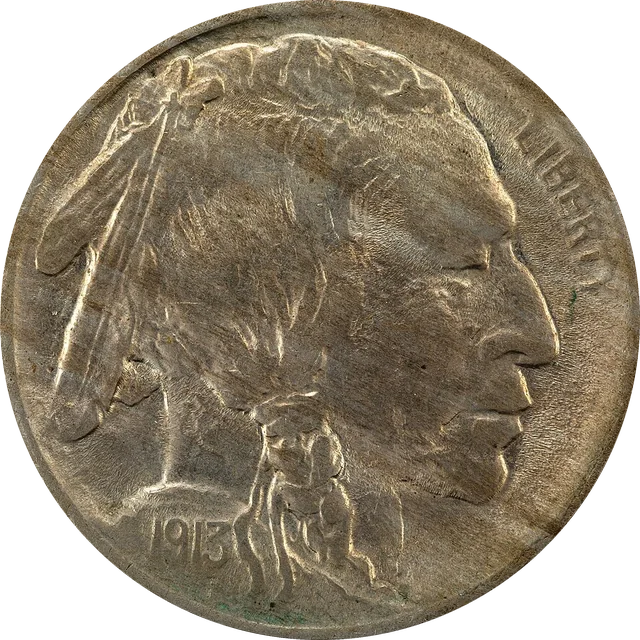
Two 1913 designs: the raised mound of Type 1 and the flat ground of Type 2
The first Buffalo nickels were given out on February 22, 1913, when President Taft presided at the groundbreaking for the National American Indian Memorial at Fort Wadsworth on Staten Island, a monument that was never built. The coin went into circulation on March 4. A week later, Chief Engraver Charles Barber reported that dies were wearing out three times faster than with the Liberty Head nickel, and the date and the denomination on the raised mound under the bison were the parts of the design most exposed to wear.
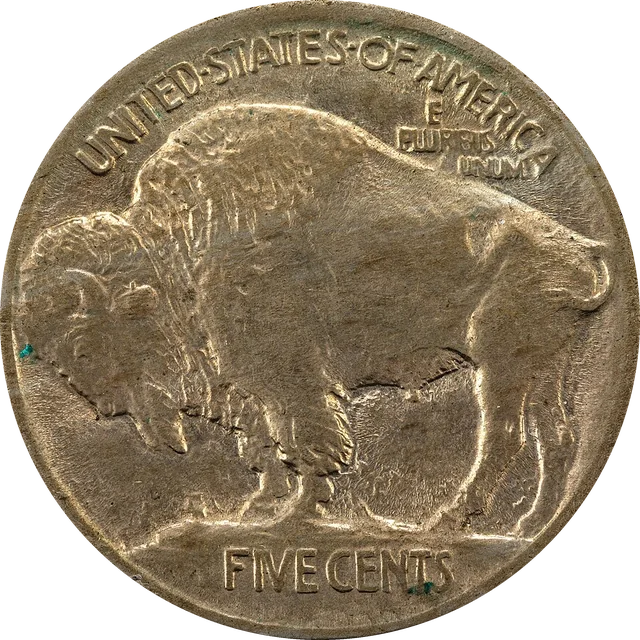
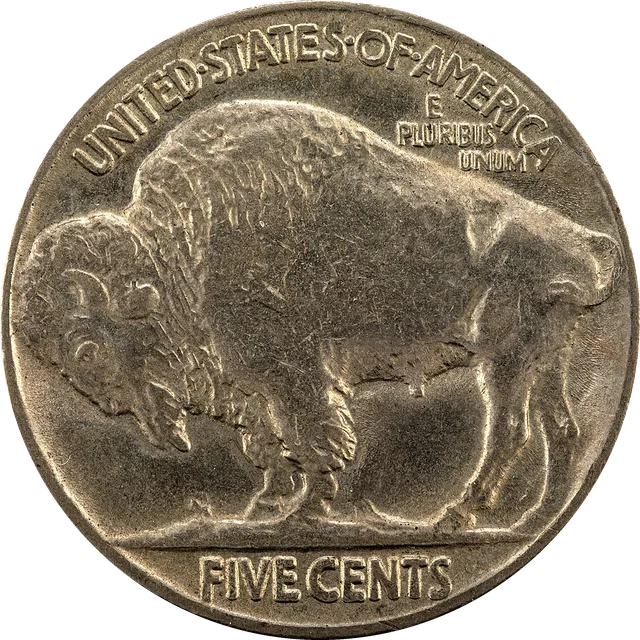
Barber's revision, approved by the designer James Earle Fraser, became the Type 2 reverse: FIVE CENTS was enlarged and set in a recessed area below a flat ground line, the layout the Mint kept for the rest of the series. Every Type 1 coin, with the bison on a raised mound and FIVE CENTS on top of it, is therefore an early-1913 piece. Both types were struck at all three mints.
Philadelphia struck more than 30 million Type 1 coins and nearly 30 million Type 2, yet only about 0.067% of the Type 2 Philadelphia coins are thought to survive, the lowest rate of any regular 1913 issue, because most circulated hard. The scarce coins come from the branch mints. San Francisco's 2,105,000 Type 1 pieces are the lowest Type 1 mintage, and its 1,209,000 Type 2 coins make the 1913-S Type 2 a key date of the series, with only about 250 estimated at MS65 or better. Denver's Type 2 coins, just over 4 million, survive in about 10,000 pieces, and an MS68 brought $143,750 at Bowers and Merena in January 2008, the highest price for any regular-strike 1913 Buffalo nickel.
Philadelphia also struck matte proofs for collectors, 1,520 Type 1 and 1,514 Type 2, and more than 59% survive because buyers kept them from the start. The recognized variety of the year is a Philadelphia Type 1 die polished so heavily that much of the bison's right front leg disappeared while the hoof remained, the Three and a Half Legs (FS-901); an NGC MS65 sold for $47,437.50 in August 2004.
What to check on this one
- To tell the types apart, look under the bison: a rounded mound with FIVE CENTS on top is Type 1, and a flat line with FIVE CENTS in a recess below it is Type 2.
- Check below FIVE CENTS for the mint mark; the 1913-S Type 2 is the key coin of the year, so confirm both the S and the type before paying a premium.
- A coin with a weak or missing leg is usually just worn; only the attributed FS-901 die, with the hoof still visible, counts as the three and a half legs variety.
- Matte proofs look nothing like mirror proofs; a 1913 nickel with an even, sandblasted-looking surface and sharp detail may be one, and light contact marks on that finish lower the grade.
Sources: Buffalo nickel (Wikipedia); 1913 nickel value (CoinValueChecker).