 CoinYearValue
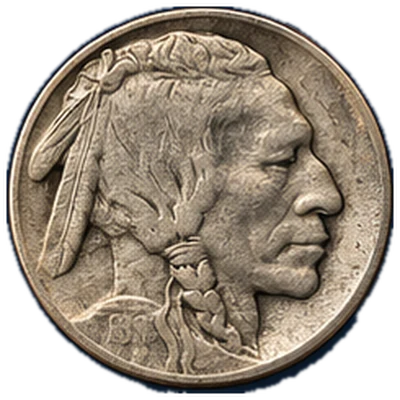
Fraser's bison nickel, a flawed first year and a planned last one
The Liberty Head nickel reached the 25-year minimum for a new design in 1908, under the Mint Act of September 26, 1890. Chief Engraver Charles Barber tried a Washington portrait and then a Lincoln, but the 1909 Lincoln cent made a Lincoln nickel pointless. Sculptor James Earle Fraser sent sketches in June 1911 and talked the Treasury out of holding a public contest. Vending machine makers, led by Clarence W. Hobbs, objected to the change in July 1912. The Mint went ahead and struck the first coins at Philadelphia on February 17, 1913.
Fraser said his Native American portrait blended features of three chiefs who sat for him, and the bison was most likely Black Diamond from the Central Park Menagerie. His small F sits under the date. The first version put the bison on a raised mound with FIVE CENTS in relief on it. Hobbs had warned that lettering raised only about 0.003 inch would not last, and by April 1913 circulating coins were visibly flattening. Barber cut the mound down to a flat line and recessed the denomination beneath it. Roughly 38 million of the first type had been made at the three mints before the change. San Francisco's output of the revised type that year was only 1,209,000, which makes the 1913-S Type 2 the hardest of the six 1913 coins.
Two famous varieties came out of the Mint's die shop. The 1918/7-D overdate happened in late 1917 when a working die already pressed from a 1917 hub took a second impression from the 1918 hub. The 1937-D three-legged nickel came from a worn, clashed reverse die at Denver that was polished so hard the bison's front leg disappeared while the hoof stayed. About 20,000 may have been struck, and PCGS estimates around 10,000 survive. Montana dealer C.L. "Cowboy" Franzen found them in late 1937, and most of the early pieces came out of the Bozeman area. Among regular dates, the 1921-S is often on poor planchets with surfaces that look like peeling skin, and the 1924-S and 1926-S are the other branch-mint dates that cost real money.
The series ended on schedule after 25 years. San Francisco made no Buffalo nickels in 1938; reverse dies first prepared for it were repunched with a D and sent to Denver, which is why some 1938-D coins show an S under the D. PCGS puts that variety at about 20,000 coins. Denver's 7,020,000 coins that year were saved by the roll as the last Buffalo date, and the Jefferson nickel took over later in 1938.
That roll saving is why a mint-state 1938-D is easy to find while many earlier dates are not. Most Buffalo nickels in old accumulations are Type 2 coins in heavy wear, and CoinWeek has shown a date set in middle grades can still be assembled on a modest budget.
What to check on this one
- On a 1937-D, the bison's front hoof should still be there under the missing leg; a coin with the leg and hoof both gone, or tool marks in the field, has been worked on.
- Weigh any 1918/7-D. A genuine one is 5.0 g, while NGC has seen fakes at 5.4 g made of a brass-like alloy.
- Check what the bison stands on in 1913: a raised mound means Type 1, a flat line with FIVE CENTS recessed below it means Type 2. The 1913-S Type 2 is the scarce one.
- Look under the D on a 1938-D with a loupe; traces of an S mean the D/S variety, and only strong examples carry much of a premium.
Sources: 1913 Buffalo Nickel Type 1: History & Collector's Guide (CoinWeek); 1913-S 5C Type Two MS67 NGC, Lot 382 (Heritage Auctions); Counterfeit Detection: 1918/7-D Buffalo Nickel (NGC); 1937-D 3-Legged Buffalo Nickel: A Collector's Guide (CoinWeek); 1938-D D Over S Buffalo Nickel Varieties (PCGS); Building a Set of Buffalo Nickels at Very Low Cost (CoinWeek).