CoinYearValue
The 1916-D key, an overlooked 1916-S, and the Barber dimes of the same year
Two different dimes carry the 1916 date. The new Mercury design was not ready on time, so the Mint kept striking Barber dimes by the million: nearly 18.5 million at Philadelphia and 5,820,000 at San Francisco, the last Barber dimes that mint ever made. The Mercury dime reached circulation on October 30, 1916. The values on this page are for the Mercury coins; a 1916 Barber dime is a separate coin with its own prices.
Denver struck only 264,000 Mercury dimes, the key date of the series. In November 1916 the Mint director told the superintendents about a large order for quarters, and Denver was instructed to strike nothing but quarters until it was filled; it did not go back to dimes until well into 1917. The 1916-D is rare in every grade, and a toned MS67 Full Bands brought $207,000 at Heritage in August 2010, then resold for $204,000 at Stack's Bowers in March 2020. It is also one of the most counterfeited U.S. coins, usually by adding a D to a Philadelphia dime.
San Francisco's 10,450,000 Mercury dimes are more available than that figure suggests, probably because people saved the new design when they first saw it and because the coins circulated widely in the West. In the 1970s a family in Helena, Montana, held a hoard of 135 uncirculated pieces. The 1916-S is still scarce in gem grades, and its strike has a quirk: weakness tends to show on the lower diagonal band rather than the center crossbands. The record is $23,000 for an MS67 at Heritage in August 2001.
Philadelphia's 22,180,080 Mercury dimes are the common 1916, though as first-year coins even worn ones carry a premium over later dates. The finest known grade is MS68 Full Bands, and an MS68+ FB brought $20,400 at Stack's Bowers in August 2020.
What to check on this one
- On a 1916-D, examine the D under magnification and have the coin authenticated before buying or selling it; added mint marks on Philadelphia dimes are the usual fake.
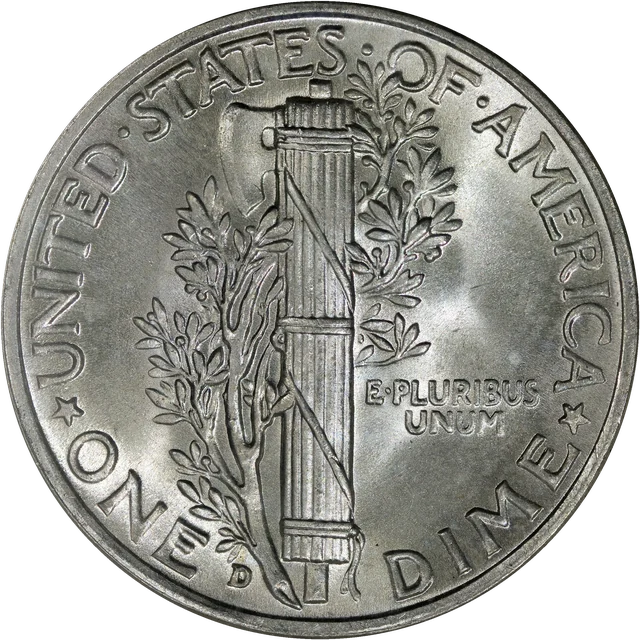
- Check the bands across the fasces on the reverse; fully separated bands (Full Bands) add a premium, and on a 1916-S the lower diagonal band is the one that tends to be weak.
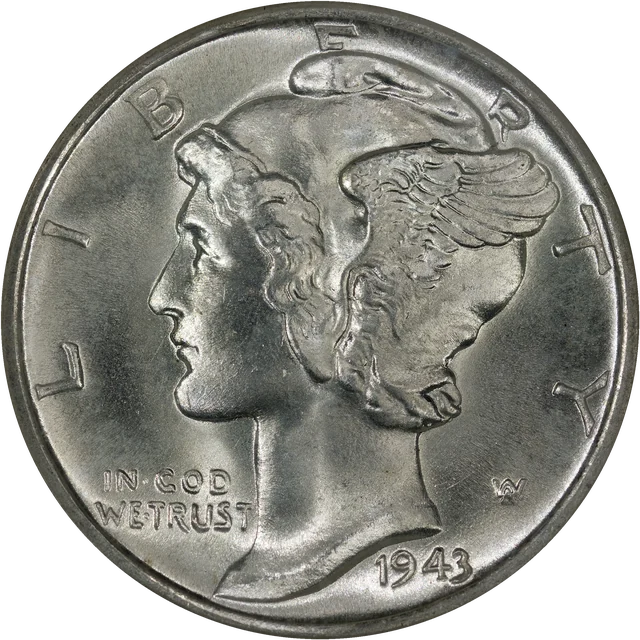
- If Liberty on your 1916 dime wears a winged cap, it is a Mercury dime; if not, it is a Barber dime and is priced as that coin.
Sources: Mercury dime (Wikipedia); 1916-S Barber dime a coin that shouldn't have been (Numismatic News); 1916-S Mercury dime a quiet oddity (Numismatic News); 1916 Mercury dime value (CoinValueChecker).