 CoinYearValue
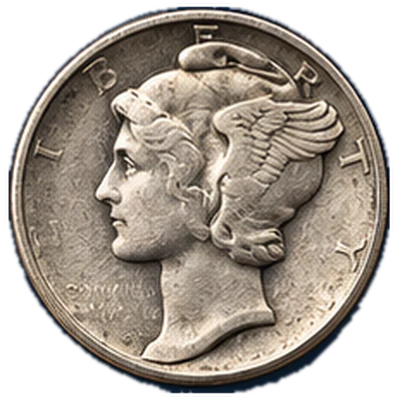
Weinman's winged Liberty, which was never meant to be Mercury
The Mint Act of 1890 allowed a coin's design to be replaced after 25 years, and by 1916 Charles Barber's dime and half dollar had both qualified. Mint Director Robert W. Woolley went outside the Mint for new work and invited three sculptors. Adolph A. Weinman, who had studied under Augustus Saint-Gaudens, won both the dime and the half dollar, and Hermon MacNeil took the quarter. Weinman's dime entered circulation in late October 1916 and stayed in production for nearly three decades.
The nickname is a mistake that stuck. Weinman's Liberty wears a soft Phrygian cap with a small wing on it, a symbol he meant to stand for freedom of thought. The god Mercury wore his wings on a hard, brimmed hat, but the public saw wings and named the coin after him anyway. The reverse shows a fasces, a bundle of rods for strength in unity with an axe for authority, wrapped in an olive branch for peace. With the country edging toward World War I, the message read as a wish for peace with a readiness to fight. Italy's Fascist Party later adopted the fasces, a connection Weinman never intended.
The key date came from a Denver Mint that barely made dimes in 1916. Philadelphia struck 22,180,080 and San Francisco 10,450,000, but Denver stopped at 264,000, possibly to concentrate on quarters. Q. David Bowers notes the first Denver delivery was on December 29, so the coins only reached circulation in 1917. PCGS estimates about 100 survive in mint state out of roughly 10,000 in all grades, and counterfeiters target it so often that CoinWeek advises buying only certified examples. The 1921 and 1921-D, with 1,230,000 and 1,080,000 struck, are the next hardest, and the 1926-S at 1,520,000 is known for weak strikes. The 1942/1 overdate was made at both Philadelphia and Denver, and on sharp examples the date reads almost like 19421.
Collectors grade the reverse closely. When the horizontal bands across the fasces are fully separated, the coin earns a Full Bands designation, and many dates are scarce that way even though they are common otherwise. The 1916-D runs the other way: PCGS's David Hall estimates that 80% or more of mint-state survivors have full bands, while PCGS had certified only about 150 Full Bands 1926-S dimes when CoinWeek counted. Most Mercury dates are not rare at all in worn condition; their scarcity is mostly a matter of high grades, and a common date can still be a condition rarity at MS66 with full bands.
Output peaked at 231,410,000 dimes in 1944, so the dimes that turn up in drawers and inheritances are mostly from the war years. John Sinnock's Roosevelt dime took over in 1946, ending Weinman's design after 30 years of dates.
What to check on this one
- On a 1916 dime, look at the D beside the fasces with a loupe. Most fake 1916-Ds are real Philadelphia coins with a D glued or tooled on, so check for a seam or a letter that does not match the style of other Denver mint marks.
- On 1942 dimes, look inside the 2 for the top of a 1; that marks the 1942/1 overdate from Philadelphia or Denver.
- Check whether the bands across the middle of the fasces are split into two clean lines. Full Bands coins sell at a premium in uncirculated grades.
- The 1921 and the 1926-S are often weakly struck, so a soft date on either is normal and does not by itself mean a fake.
Sources: Mercury Dime, 1916-1945: History and Value (CoinWeek); 1916-D Mercury Dime Collector's Guide (CoinWeek); The 6 Classic Mercury Dime Key Dates & Rarities (CoinWeek); The Top 50 U.S. Coins of All Time (PCGS); Walking Liberty Half Dollar, 1916-1947 (CoinWeek); Top 50 Most Commonly Counterfeited U.S. Coins (NGC); 1916-D 10C, PCGS CoinFacts.