CoinYearValue
Small Denver and San Francisco mintages that turn scarce above MS64
Denver and San Francisco each struck under 5 million dimes in 1927, 4,812,000 and 4,770,000, while Philadelphia made 28,080,000. Even so, worn 1927 dimes from all three mints are easy to find. The differences show up in Mint State, and above all in Full Bands grades.
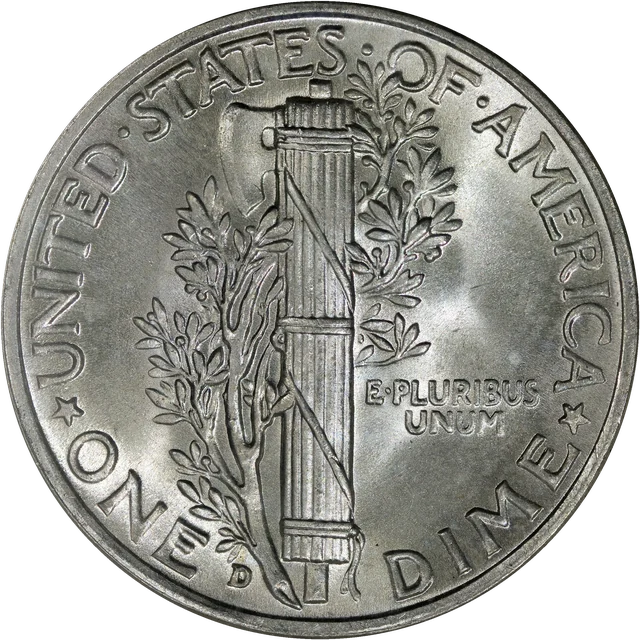
Through MS64, 1927-D dimes turn up with or without Full Bands without much trouble. Above that the supply hits a wall: MS65 FB coins are scarce, MS66 or better is exceptionally rare, and most examples top out around MS66. Denver's strike quality was inconsistent, and the record, $35,075 for an MS66 FB at Bowers and Merena in November 2006, has stood for nearly two decades.
The 1927-S is widely available in lower uncirculated grades, but fewer than 100 have been certified at MS65 FB or better. MS66 FB coins are genuinely rare, and anything finer almost never appears at auction. Without Full Bands, the record is $7,500 for an MS67 at Heritage in December 2023.
Most surviving Philadelphia coins are well worn, and like many Mercury dimes most were not struck hard enough to show clean band separation. A sharp coin with original luster and no bag marks is tough to find, and an MS67+ FB set the record at $15,600 at Heritage in January 2019. No errors have been attributed specifically to the 1927 date, though the usual Mercury dime errors can appear on it.
What to check on this one
- On a 1927-D or 1927-S above MS64, the bands decide the price; a coin with merged bands is worth a fraction of a Full Bands example in the same grade.
- Check a Philadelphia 1927 for bag marks as well as bands; a sharp, clean, lustrous coin is far scarcer than the mintage suggests.
- For doubling, check the date digits with a loupe first; that is where it is usually easiest to see.
Sources: 1927 Mercury dime value (CoinValueChecker); Mercury dime (Wikipedia).