 CoinYearValue
Fake and altered coins: the common ones and how to check
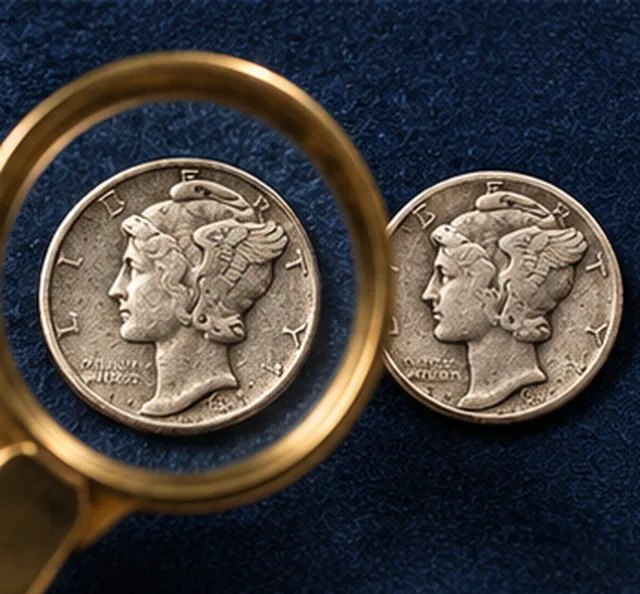
Most fake U.S. coins that reach a kitchen table fall into two groups. Some are genuine common coins that someone changed: a mint mark glued on, a digit scraped, a steel cent plated copper. The rest are made from scratch, from crude cast pieces to struck copies from Chinese factories that come in fake grading holders.
A scale, a magnet, calipers and a 10x loupe will catch a lot of both. They won't catch everything, and the last section covers when to stop testing and send a coin to a grading service.
Weight, size and magnet checks
Start with numbers. A pocket scale with 0.01-gram steps is cheap, and it answers most questions about metal in seconds.
| Coin | Weight | Diameter | Magnet |
|---|---|---|---|
| Bronze cent, 1909–1942 and 1944–1982 | 3.11 g | 19 mm | No pull |
| 1943 steel cent | 2.7 g | 19 mm | Sticks |
| Zinc cent, 1982 on | 2.5 g | 19 mm | No pull |
| Silver dime, 1964 and earlier | 2.5 g | No pull | |
| Silver quarter, 1964 and earlier | 6.25 g | No pull | |
| Silver half, 1964 | 12.5 g | No pull | |
| Morgan dollar | 26.73 g | 38.1 mm, 2.4 mm thick | No pull |
Silver and copper are both diamagnetic, which means a household magnet has no visible pull on them. If a “silver dollar” or a “copper” 1943 cent sticks, it is not what it claims to be.
Passing these tests proves less than failing them. Counterfeiters now match weight and metal on good copies. CoinWeek documented a fake 1893-O Morgan that weighed 27.0 grams and tested as silver, and was caught only by its wrong reverse design.
1943 copper cents
The Mint made 1943 cents from zinc-coated steel, but a few leftover bronze blanks were struck by mistake. Only a small number are known, and a genuine one is worth $200,000–350,000 (see the 1943 penny page). Most copper-colored 1943 cents turn out to be one of two fakes:
- Plated steel cents. An ordinary 1943 coated with copper. The magnet catches these at once.
- Altered dates. A bronze 1945, 1948 or 1949 cent with the last digit cut or reshaped into a 3. This one passes the magnet test, so look at the 3 under a loupe for tool marks, which gather around a reworked digit.
Genuine bronze 1943s weigh the same 3.11 grams as any copper cent of the period. That figure can't clear a coin by itself: an altered 1948 is also copper colored, ignores the magnet and hits the same weight, so a piece that passes all three checks still goes to an authenticator.
Added and removed mint marks
Adding a single letter turns a common coin into a key date, so the key-date cents are the main targets.
- 1909-S VDB. A Philadelphia 1909 VDB (27,995,000 made) gets an S added below the date. CopperCoins records only 4 obverse dies for the real 1909-S VDB, and the S sits at a slightly different spot and tilt on each. A letter whose placement fits none of them should be treated as added.
- 1914-D. Fakers add a D to a 1914 Philadelphia cent, or scrape half of the 4 on a 1944-D so it reads 1914. The 1944 fails on the front: it has Brenner's VDB on Lincoln's shoulder, and 1914 cents don't. A genuine 1914-D mint mark is narrow and sits in a small depression left by the punch.
- 1922 No D. Here the D gets tooled off a 1922-D. The collectible No D came from a worn, heavily polished obverse die paired with a fresh reverse, so the back of a real one looks sharp while the front looks tired. A soft reverse argues against it.
- 1931-S. Fakers add an S to a 1931 Philadelphia cent. Five genuine dies are documented, and a crisp S proves nothing unless its position lines up with one of them.
Silver dollars get a nastier version. The forger drills a narrow channel in through the edge beneath the mint mark area, raises a letter from inside with a shaped tool, then plugs the channel and files the edge to imitate reeding. CoinWeek describes this on 1889-S Morgans, where a genuine coin has 186 or 187 reeds on the edge. Breaks or uneven reeding near the mint mark point to tampering. A glued or added letter on a cent can show a seam around its base under magnification.
Our mint marks guide shows where each series puts its letter.
Altered dates
Besides the 1943 and 1914 cases, any date where one digit separates a common coin from a rare one gets altered. NGC's advice applies to all of them: tool marks concentrate around the changed digit. Compare the suspect digit to the ones beside it for height, width and the shape of its tips.
1955 doubled die fakes
The genuine 1955 doubled die sells for $1,500–3,000 worn and was struck from a single obverse die. That makes it easy to check against a few markers:
- Strong, widely spread doubling shows on the motto, on LIBERTY and on all four digits, and you can see it with the naked eye.
- PCGS lists faint vertical polish marks on the back, just left of the T in CENT, as a diagnostic of the real reverse die.
- If only the final 5 looks doubled, and the doubling is flat and smeared, the coin came from a worn die. Sellers call these the “poor man's doubled die”; they are genuine 1955 cents with almost no premium.
Counterfeits of the real variety exist in quantity, and an uncertified one should be treated as a fake until an expert says otherwise.
Cast and Chinese counterfeit Morgan dollars
Cast fakes are the crude end. NGC lists the signs: a seam around the edge, a grainy surface, and a dull sound when tapped, because a cast piece doesn't ring like a struck coin.
Struck copies from China are better made. Many are base metal plated to look like silver, so the magnet, scale and calipers catch them. CoinWeek reports they are sold on sites like AliExpress and Taobao as replicas or souvenirs, then resold elsewhere as genuine. Carson City dates are favorites; the 1881-CC is one of the most counterfeited Morgans, and every CC date has been copied.
Fake holders are now part of the package:
- At least 13 sellers were found offering fake 1881-CC Morgans under the same counterfeit PCGS certification number, 27886283.
- Fake slabs show misaligned label text, weak holograms, and barcodes that don't scan.
- QR codes on fake labels can lead to copycat verification sites such as pcgs-cn.com or pcgsverify.cn that “confirm” any number.
Type the certification number yourself at pcgs.com/cert or on NGC's site, and check that the coin pictured in the result matches the one in your hand. Price helps too: a CC Morgan offered far below market, especially from a seller in China or Hong Kong, is a fake until proven otherwise. Common Morgans like the 1921 get faked as well, sometimes in cloned genuine labels. See our Morgan dollar values for what each date should cost.
When to get authentication
Use the home tests to rule coins out, not to rule them in. Send a coin to PCGS or NGC when:
- If genuine, it would sell for several hundred dollars or more. That covers every key-date cent above, the 1955 doubled die, and any CC Morgan.
- It passes weight and magnet tests but the mint mark or date looks even slightly off to you.
- You plan to sell it. PCGS CoinFacts says experts strongly advise against buying a raw 1914-D, and careful buyers apply the same rule to every key date.
Check the current fee schedule on the grading service's site before you send anything, since tiers and prices change. Our grading guide explains how submissions work, and when buying, stick to dealers who belong to the ANA or the Professional Numismatists Guild.
Supplies mentioned in this guide
As an Amazon Associate I earn from qualifying purchases. These are paid links. Affiliate disclosure.
Questions
How can I tell if my 1943 copper penny is real?
Try a magnet first. If it sticks, it is a plated steel cent. If it doesn't stick, weigh it; a genuine one is about 3.11 grams. Then look closely at the 3, since most non-magnetic ones are 1945, 1948 or 1949 cents with an altered last digit. A coin that passes all of that still needs PCGS or NGC authentication.
Does a magnet test prove a silver dollar is real?
No. Silver doesn't stick to a magnet, so a dollar that sticks is fake. But many fakes are non-magnetic too, and some good copies even have the right weight and silver content. The magnet only rules coins out.
What does a real Morgan dollar weigh?
26.73 grams, with a 38.1 mm diameter and a thickness of about 2.4 mm.
Can a fake coin be in a real-looking PCGS or NGC holder?
Yes. Counterfeit holders with cloned labels are common on Chinese-made fakes. Look up the certification number yourself on the grading service's official website and compare the photo to your coin.
Is a 1914 penny with VDB on the shoulder a 1914-D?
No. Lincoln cents dated before 1918 have no initials on the shoulder. A 1914 date with VDB on the shoulder is almost certainly a 1944 cent with the 4 altered.
Sources
- Counterfeit Detection (NGC)
- 1943 steel cent (Wikipedia)
- 1909 Lincoln Cent Date Guide (CopperCoins)
- 1914 Lincoln Cent Date Guide (CopperCoins)
- 1931 Lincoln Cent Date Guide (CopperCoins)
- Counterfeit Mintmarks: How to Spot Altered Coins Before You Buy (CoinWeek)
- 1955 1C Doubled Die Obverse BN, PCGS CoinFacts
- 1955 doubled-die cent (Wikipedia)
- 1914-D 1C RD, PCGS CoinFacts
- When the Reverse Is Wrong: A Counterfeit 1893-O Morgan Dollar (CoinWeek)
- Fun With Fakes: Counterfeit Carson City Dollars (CoinWeek)
- Fun with Fakes: Chinese Counterfeit Coins, Slabs and Website (CoinWeek)
- Morgan dollar (Wikipedia)
- Lincoln cent (Wikipedia)
- Washington quarter (Wikipedia)
- Kennedy half dollar (Wikipedia)
- Dime (United States coin) (Wikipedia)
- Diamagnetism (Wikipedia)
Checked October 19, 2026. See our editorial policy for how we source facts.