 CoinYearValue
How to clean coins, and why you usually shouldn't
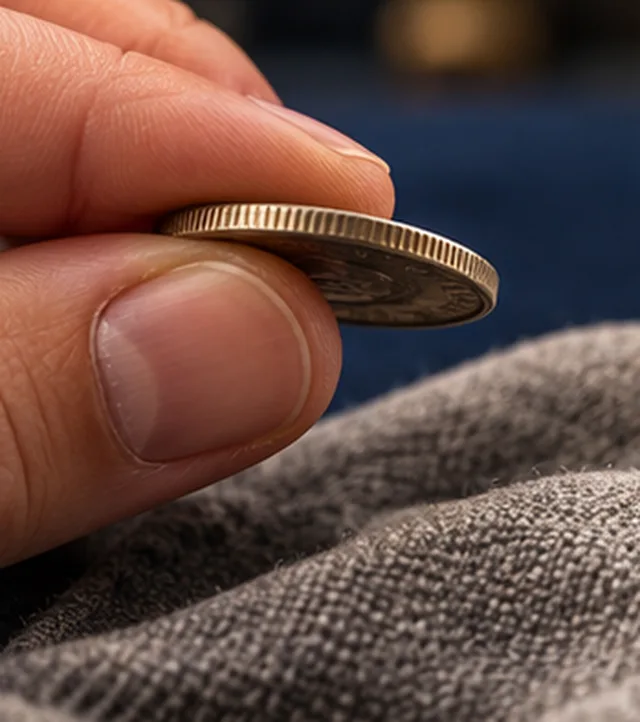
No. A 1901-S Barber quarter graded Good with cleaning sold for $2,585 at a Heritage auction in January 2013, roughly $1,000 to $1,500 less than a problem-free coin in the same grade would bring, according to Coin World's market analysis. The person who scrubbed that quarter probably thought they were making it look better.
The value of an old coin sits in its surface. Original luster, the slow toning that builds over decades, and fine high-point detail are what graders and buyers pay for, and nearly every home cleaning method removes some of that metal and color for good. As Kenneth Bressett and A. Kosoff put it, a coin stripped of its original surface can never be fully restored.
What cleaning does to a coin's surface
A coin fresh from the mint has luster, the frosty or satiny shine on its surface. Over the years silver tones and copper darkens to brown. Collectors call that layer patina and treat it as part of the coin.
Home cleaning goes wrong in a few predictable ways:
- Rubbing or brushing. Even a soft toothbrush leaves fine parallel scratches called hairlines. Baking soda, scouring powder, pencil erasers and metal polish are abrasives and do the same thing faster.
- Dipping. Commercial silver dips are a weak acid that dissolves tarnish along with a thin layer of metal. Conservator Susan Maltby has explained in Coin World that the thiourea in these dips bonds to silver and cannot be rinsed off, so a dipped coin tends to tarnish again, and faster, because the acid also etches the surface.
- Polishing and buffing. These give a bright, glassy look that no mint ever produced.
- Whizzing. A rotary wire brush pushes metal around to fake luster. It softens lettering and design edges.
- Home remedies. Vinegar and lemon juice are acids and eat into metal. Olive oil is often suggested for copper, but Maltby notes its fatty acids can corrode copper alloys and the oil traps dust.
Copper is the least forgiving. A cent cleaned bright orange looks wrong to any experienced buyer, and cleaned copper is often artificially retoned brown to hide it, which graders also look for.
How graders spot a cleaned coin
PCGS and NGC will not give a numeric grade to a coin they judge improperly cleaned. Instead the coin gets a "Details" grade, such as "VF Details, Improperly Cleaned," which tells every future buyer about the problem. PCGS defines improper cleaning as surface damage from any form of abrasive cleaning. NGC uses more specific terms when the method is clear:
| Label | What it means |
|---|---|
| Improperly Cleaned | Unskilled cleaning, method uncertain |
| Brushed | Wiped with an abrasive brush |
| Polished | Brightened by rubbing |
| Burnished | Aggressive cleaning leaving a very bright, unnatural sheen |
| Whizzed | Rotary wire brush; lettering and details distorted |
| Artificial Color | Copper chemically dipped or cleaned |
| Artificial Toning | Color added with chemicals or heat |
What graders look for is simple to describe and hard to hide. Hairlines show up when the coin is tipped under a single bright light. Luster that is broken, dull, or too glossy for the coin's wear level is another giveaway. Color that sits wrong for the metal and age, bright metal deep in the recesses next to toned high points, or residue in the letters all point to work done after the coin left circulation. David Lange, writing for NGC, notes that many owners only learn a coin was cleaned when it comes back from a grading service. Very light cleaning that did no harm can still get a normal grade, so NGC does not treat every washed coin as damaged. For more on how grades are set, see our coin grading guide.
What cleaning has cost real coins
These are auction results Coin World reported, each comparing a cleaned coin with an unproblemed one of similar wear.
| Coin | Cleaned coin sold for | Comparable original coin |
|---|---|---|
| 1901-S Barber quarter, Good Details, Cleaned (PCGS) | $2,585 (2013) | About $1,000 to $1,500 more for a problem-free Good 4 |
| 1878-CC $20 gold, AU Details, Harshly Cleaned (PCGS) | $4,800 (2019) | $12,600 for an AU-50 with no qualifiers (2019) |
| 1892-S Morgan dollar, Unc Details, Altered Surfaces (PCGS) | $16,450 (2016) | $30,550 for an NGC MS-60 (2014) |
The 1878-CC lost more than 60% of its value. The 1892-S brought about what an About Uncirculated coin would, even though it had no wear. Lower prices follow the same pattern. A common Morgan dollar that trades for its silver loses little by being cleaned. It is the scarce date carrying a collector premium that gets hurt, and you may not know which one you have. Check the year page, such as the 1889 silver dollar with its scarce CC version, before touching anything.
The two things that are safe to do
Q. David Bowers, writing in Coin World, describes acceptable cleaning as using inert substances, like water or acetone, to remove grease, grime and residue. Neither touches the metal or the toning. Both remove only what is sitting on top.
Rinse in distilled water
- Hold the coin by its edge over a folded towel.
- Rinse it in distilled water, not tap water, which carries chlorine. A drop of mild dish soap is acceptable for a greasy coin.
- Do not rub. Let the water do the work.
- Pat dry with a soft cotton cloth or let it air dry face up. Never wipe across the surface.
Acetone for grease and sticky residue
Pure acetone from a hardware store dissolves oils, tape adhesive and the early sticky film that soft vinyl holders leave behind. Use it in a ventilated room away from flame, in a glass dish:
- Soak the coin for a minute or two.
- Lift it out and rinse in a second dish of fresh acetone.
- Rinse in distilled water and let it air dry.
That is the whole list. Acetone does not remove tarnish, toning or corrosion, and it should not. Use it on the bare coin only, never on a coin still in a holder.
PVC damage and when to use a conservator
Many old collections were stored in soft, flexible vinyl flips. To make them pliable, manufacturers added a plasticizer that gives off gases, and in warm, damp storage those gases attack the metal. The first sign is a greasy film or green streaks, often on silver dollars. A collector writing in Coin World described buying a 1922-S Peace dollar with green PVC streaks for $49 because, at that stage, conservation can remove it. Once the residue is caked on or has etched pits into the metal, the damage is permanent. Move any coin out of a soft flip right away and into an inert holder; our coin storage guide lists safe ones.
For a coin worth real money, let a professional do it. NGC sends coins with active residue to its sister company, Numismatic Conservation Services (NCS), before it will grade them, and PCGS offers its own restoration service. ANACS added conservation in 2013 and said it removes PVC, debris, glue, stains and haze, but that active corrosion usually cannot be treated and red or red-brown copper always looks worse after an attempt, so it declines those. Conservation can also reveal old cleaning that the residue was hiding. Fees change, so check each service's current schedule before you submit.
The dealer trade draws the same line: the Professional Numismatists Guild's code of ethics says solvents and commercial dilute acids used by qualified professionals are not doctoring, while polishing, whizzing and artificial toning meant to make a coin look better are.
What never to do
- Never rub, brush or wipe a coin, even with a soft cloth.
- Skip baking soda, toothpaste, metal polish, erasers and jewelry cleaner.
- Don't dip silver or copper yourself, or soak coins in vinegar, lemon juice, cola or salt water.
- Keep coins away from ultrasonic cleaners and rotary tools.
- Don't coat a coin with oil, wax or lacquer to make it shine.
- Leave corrosion and black crust alone; on old or buried coins the metal underneath can be brittle.
If you have a jar or an inherited collection of dirty coins, leave them as they are and sort them first. Buyers price cleaning as damage, as the sales above show, while honest dirt costs you nothing. When you're ready to sell, our guide to where to sell old coins covers the options. And if a coin's surface looks unnaturally bright when you buy it, our page on fake and altered coins explains what else to check.
Supplies mentioned in this guide
As an Amazon Associate I earn from qualifying purchases. These are paid links. Affiliate disclosure.
Questions
Does cleaning a coin ever increase its value?
Almost never for a collector coin. Abrasive or chemical cleaning removes original surface, and PCGS and NGC give such coins Details grades that sell at a discount. Professional conservation that removes only foreign material, such as PVC residue, can help.
Is it OK to clean coins that are only worth their silver?
A common silver coin bought for melt loses little, but you gain nothing either, since bullion buyers pay by weight. Rinsing in distilled water is enough, and you avoid ruining a scarce date you didn't recognize.
Can I clean coins with vinegar or baking soda?
No. Vinegar is an acid that etches metal and baking soda is an abrasive that leaves hairlines. Both are easy for graders to spot.
Will a grading service tell me if my coin was cleaned?
Yes. PCGS and NGC note it on the holder with a Details grade and a description such as Improperly Cleaned, instead of a numeric grade.
How do I remove green gunk from a coin?
If it is a soft film from a vinyl holder, a soak in pure acetone may lift it. If it is crusty or the coin is valuable, send it to a conservation service such as NCS instead of scraping it.
Sources
- Cleaning of 1901-S Barber quarter dropped price at least $1,000 (Coin World, Steve Roach, Oct 2014)
- 'Harshly Cleaned' 1878-CC gold $20 means opportunity (Coin World, Steve Roach, Jun 2019)
- Cleaning 1892-S Morgan dollar brings lower price (Coin World, Steve Roach, Jul 2016)
- Cleaning meaning (Coin World, Q. David Bowers, Aug 2012)
- Do you clean, tone or coat coins in your collection? (Coin World, Susan L. Maltby, Oct 2016)
- Why you should avoid lacquering your coins (Coin World, Susan L. Maltby, Jan 2017)
- PVC in online coin auctions (Coin World blog)
- ANACS adds coin conservation (Coin World, Sep 2013)
- Details Grading (NGC)
- USA Coin Album (NGC, David W. Lange, Oct 2011)
- Coin cleaning (Wikipedia)
- Professional Coin Grading Service (Wikipedia)
- Numismatic Guaranty Company (Wikipedia)
- PNG Code of Ethics (Professional Numismatists Guild)
- Cushion, don't clean (Coin World, Susan L. Maltby, Jun 2011)
Checked October 19, 2026. See our editorial policy for how we source facts.