 CoinYearValue
How to store coins without damaging them
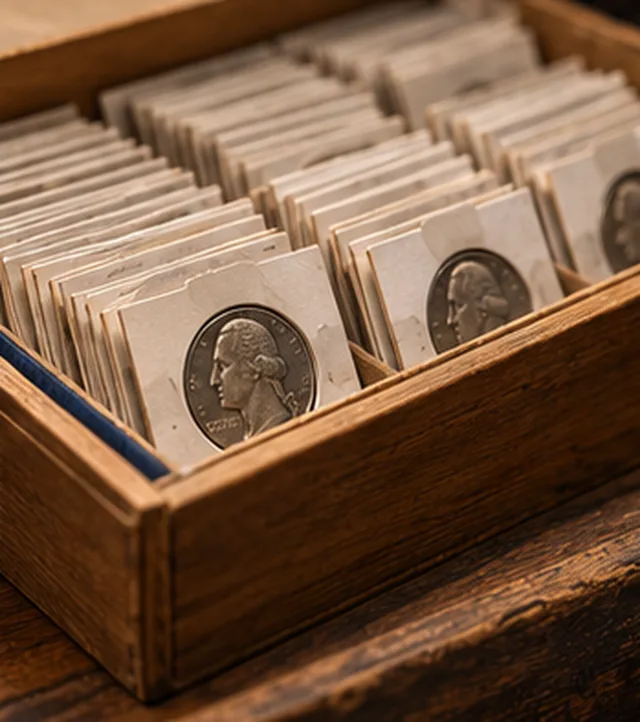
Coins rarely get ruined by age. They get ruined by what they sit in and the air around them. Corrosion, spotting and residue from a bad holder lower a coin's grade, and cleaning makes it worse rather than better.
The rules are short: holders made of stable plastic, dry air at a steady temperature, nothing nearby that gives off sulfur or acid, and fingers off the faces. The humidity and temperature figures below come from museum conservation guidance.
Why soft PVC flips damage coins
The soft, clear, slightly sticky two-pocket flips sold for decades are usually made of flexible polyvinyl chloride. PVC is rigid by nature; to make it soft, manufacturers add plasticizers, and those are not chemically bonded to the plastic. They leach and migrate out over time. The Canadian Conservation Institute notes that plasticizer from flexible PVC moves to the surface and can carry onto materials it touches. On a coin, that means a film of residue sitting on the metal.
Grading services treat this as a real problem. NGC says coins stored in highly reactive paper or plastic storage media can be ineligible for a numeric grade, and coins with active surface residues have to be professionally conserved by its affiliate NCS before NGC will grade them. NGC adds that a details coin's value depends on how bad the problem is and where it sits.
If you find coins in old soft flips, move them to a stable holder now. Don't rub off any residue and don't use household cleaners; see should you clean old coins for why. A valuable coin with visible residue is a job for a conservation service.
Safe holder materials
Look for holders that say PVC-free and name the plastic. These are the common choices:
| Material | Where you see it | Notes |
|---|---|---|
| Polyester film (PET, sold as Mylar) | Windows in cardboard 2x2s, archival flips | Chemically stable; the Library of Congress uses this film for archival storage of documents |
| Rigid hard plastic | Snap-together capsules, tubes, slab shells | Good for single coins and rolls; buy ones sold as PVC-free |
| Acid-free board | Better albums and storage boxes | Conservators recommend buffered acid-free board over ordinary cardboard |
| Flexible PVC | Old soft flips, some cheap pages | Avoid for anything you plan to keep |
If a flip's packaging doesn't name the plastic, treat it as PVC.
Cardboard 2x2s, flips and capsules
The cardboard 2x2 with a polyester window is the cheapest safe holder. Fold it over the coin, staple it on three sides, and press the staples flat with pliers so they can't scratch the next holder in the box. Write the date, mint mark, grade and what you paid on the cardboard before you put the coin in.
The weakness of a 2x2 is the cardboard. Ordinary board is acidic, and the Canadian Conservation Institute warns that acidic paper and cardboard can stain objects by contact. For long-term storage of better coins, a hard capsule or an archival flip is safer. For pocket change and coins you are sorting, 2x2s are fine.
Hard capsules fit one coin snugly and keep air movement low. Buy the exact size for the coin; a capsule that is too big lets the coin rattle and rub.
Folders versus albums
A folder is a cardboard panel with holes you press coins into. Both faces of each coin stay open to the air, and the coins touch the board. Folders are cheap and good for filling a date set from circulation, such as Lincoln cents, but they are not long-term storage for uncirculated or valuable coins.
An album adds clear slides over each side, which protects the faces from fingers and rubbing. The page board still touches the coin's edge, so the quality of that board matters. Albums built from acid-free materials are worth the higher price for a set you intend to keep.
Old albums deserve a look. Sulfur compounds are the usual cause of toning, and older albums were not built from tested materials. If coins in an old album are picking up color, move them before it goes further.
Slabs and tubes
A slab is the sealed, tamper-evident holder a grading service puts a coin in, with a label, barcode and hologram. Genuine PCGS slabs are sonically sealed, while many counterfeit slabs simply snap together, which is one reason to buy expensive slabbed coins from known sellers. Slabs protect against handling and make resale easier, but they are not a reason to ignore humidity. Store slabs upright in a box made for them, and don't stack them loose where they can scratch each other. Grading costs are covered in the grading guide.
Hard plastic tubes are the standard for rolls of the same coin, including bullion and junk silver. Fill the tube so coins don't slide, and screw the cap on fully. Paper bank rolls are fine for coins you will spend or search, as in coin roll hunting, but acidic paper is not where better coins should live.
Humidity and temperature targets
For metal, damp air is the main enemy. The Canadian Conservation Institute's guidance is blunt: the lower the relative humidity the better, and above 75% RH all corrosion speeds up a lot. Salt left by fingers turns into a corrosive solution once humidity passes 75%. Museums that hold sensitive metal collections set dry rooms at 0 to 30% RH. Silver stays bright in dry air but tarnishes faster when it is damp and sulfur compounds are present.
- Humidity: keep it well below 75% and as low as you reasonably can. A cheap digital hygrometer inside the storage box tells you where you stand.
- Temperature: CCI suggests keeping storage below 25°C (77°F) in summer and above 5°C (41°F) in winter.
- Avoid sudden drops. A temperature drop of more than 10°C (18°F) can push air to 100% RH and leave condensation on the coins.
- Avoid cold spots. Damp is usually humid air meeting a cold surface. Keep boxes at least 10 cm (4 inches) from exterior walls and cold floors.
In practice that rules out attics, garages, and basements without dehumidification. An interior closet in the living space is usually the best spot in a house.
Silica gel and what else goes in the box
Silica gel is the standard desiccant, and museums and libraries use it to control humidity in storage. It only helps inside a closed container such as a sealed plastic box or a safe; in an open room it saturates quickly. Indicating gel changes color as it absorbs water, so you can see when to swap it. Once saturated, it can be dried and reused by heating to about 120°C (248°F) for one to two hours.
Keep these out of the same box or cabinet, because they give off sulfur or acids that tarnish and corrode metal:
- Rubber bands and natural rubber
- Wool and wool felt
- Oak drawers and similar woods, plus fresh paint (CCI advises letting coatings dry three to four weeks before use)
- Ordinary paper envelopes and cardboard boxes for long-term storage
Handle coins by the edges, over a soft surface. Skin leaves salt and oil, and that salt is what turns corrosive in damp air.
Safe deposit boxes and insurance
A bank box protects against theft and fire at home, but the FDIC is clear that safe deposit boxes and their contents are not covered by deposit insurance. If the box is damaged or emptied, the FDIC will not pay for what was in it. Ask the bank what, if anything, it covers, and get the answer in writing.
A box also has its own climate. Put a small packet of silica gel in a sealed container inside the box, and check it on each visit.
Homeowners and renters policies commonly limit how much they pay for each category of personal property. Read your policy for its limits on money, coins and collectibles, and ask about scheduling the collection as its own item, which is widely available. Keep an inventory with photos, the date and mint mark of each coin, grades and receipts, and store a copy somewhere other than with the coins. That inventory also helps your heirs; see the inherited collection guide.
Supplies mentioned in this guide
As an Amazon Associate I earn from qualifying purchases. These are paid links. Affiliate disclosure.
Questions
Are soft plastic coin flips safe?
Not if they are flexible PVC. The plasticizers that keep them soft migrate out over time and leave residue on coins. Use PVC-free flips made of polyester (Mylar) or hard capsules.
What humidity should I store coins at?
As low as practical, and always well below 75% relative humidity, where corrosion speeds up sharply. Museums keep sensitive metal collections at 30% or less.
Are coins in a safe deposit box insured?
Not by the FDIC. Safe deposit box contents are not deposits. Check your homeowners or renters policy, or buy separate coverage.
How do I reuse silica gel?
Heat saturated gel to about 120°C (248°F) for one to two hours to dry it out, then put it back in the sealed container.
Sources
- Polyvinyl chloride (Wikipedia)
- Agent of deterioration: pollutants, Canadian Conservation Institute
- Agent of deterioration: incorrect relative humidity, Canadian Conservation Institute
- Agent of deterioration: incorrect temperature, Canadian Conservation Institute
- Details grading, NGC
- BoPET (Wikipedia)
- Coin slab (Wikipedia)
- Toning (coin) (Wikipedia)
- Silica gel (Wikipedia)
- Understanding deposit insurance, FDIC
- Home insurance (Wikipedia)
Checked October 19, 2026. See our editorial policy for how we source facts.