CoinYearValue
A common date that holds the record price for any Mercury dime
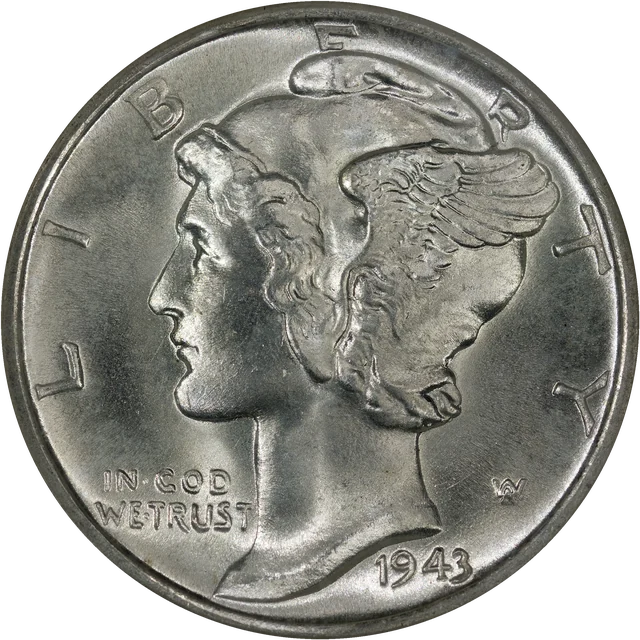
The 1938-S is an ordinary coin in circulated grades, and thousands of uncirculated Full Bands examples exist through MS66. Above that the population falls off a cliff, and in June 2019 a rainbow-toned 1938-S graded MS68+ FB, with a CAC sticker, sold for $364,250, the highest auction price for any Mercury dime. San Francisco struck 8,090,000 that year.
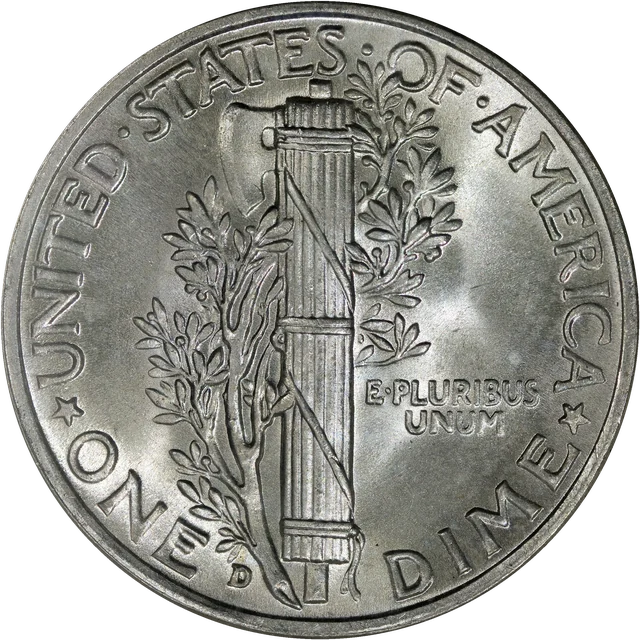
Denver made only 5,537,000, the smallest of the three, yet Full Bands 1938-D dimes are surprisingly available because Denver struck them well. That is a contrast with dates where a sharp coin can take years to find, and in circulated grades the 1938-D stays affordable for set builders.
Most 1938 Philadelphia dimes turn up well worn. People spent them rather than saving them, with the Depression still fresh, and like many Mercury dimes a lot of Philadelphia strikes came off the press soft in the center, losing detail before they ever circulated. Anything in MS67 or above takes real searching, and the Full Bands record is $14,375 for an MS68 sold by Bowers and Merena in November 2006.
Philadelphia also made 8,728 proofs, struck from polished dies on carefully prepared planchets for mirror fields no business strike has. Most grade PR64 to PR67, PR68 and finer are genuinely rare, very few show any cameo contrast, and a PR69 sold for $32,200 at Heritage in February 2005. A doubled die obverse is known as well.
What to check on this one
- For the 1938 doubled die, check the date numerals first, then look for splitting or notching on LI and TY in LIBERTY with at least a 10x loupe.
- On a raw Philadelphia 1938, look hard at the center bands; many are soft, so a genuine Full Bands coin is a real find.
- A 1938-S in MS67 or better is a different coin from the common grades; have one certified before pricing it.
Sources: 1938 Mercury dime value (CoinValueChecker); Mercury dime (Wikipedia).