CoinYearValue
A legendary Full Bands 1939-S, and the one year of regular proof cameos
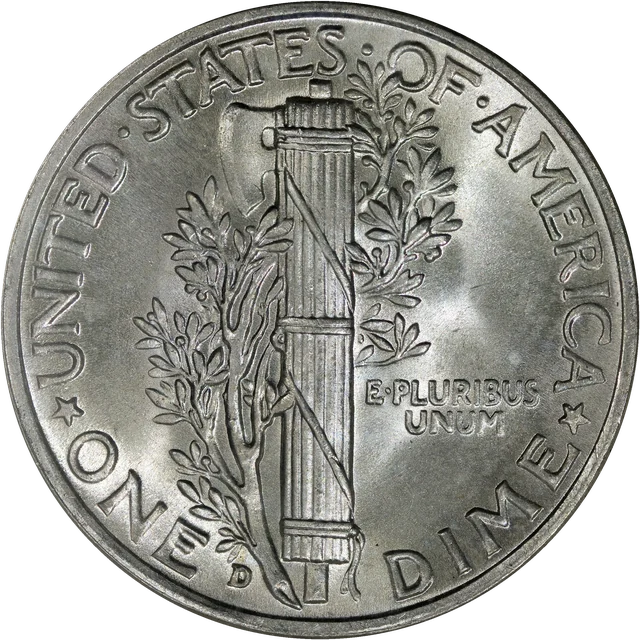
San Francisco's 10,540,000 was the smallest of the three business-strike mintages, which makes the 1939-S the semi-key of the year. Circulated examples carry only a small premium, but the gap widens in gem grades, and Full Bands pieces carry the steepest premiums of any 1939 dime. Its reputation is such that other tough Full Bands dates, like the 1935-D, are judged by comparison with it. Without Full Bands, an MS68 holds the record at $2,160, set in 2019.
The 1939-D is easy to find and cheap in circulated and lower Mint State grades, yet it is the most expensive 1939 dime ever sold: an MS69 Full Bands brought $42,300 at Legend Rare Coin Auctions in September 2019.
Philadelphia's 67,740,000 coins are common through MS67, but Full Bands examples are another matter. A problem with collar preparation seems to have kept metal from fully filling the die on most strikes, so sharply struck coins are scarce. The Full Bands record is $12,650 at Heritage in August 2000.
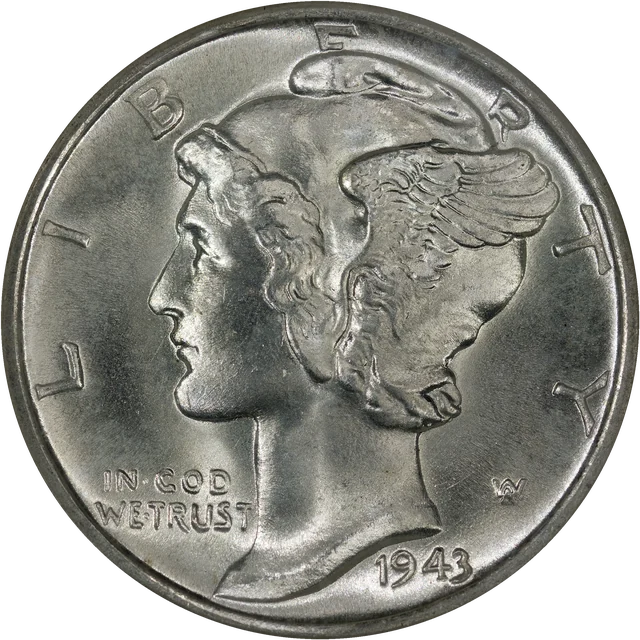
Of the 9,321 proofs made at Philadelphia, perhaps a couple thousand survive, and a PR68+ sold for $21,600 at Heritage in August 2021. 1939 is the only year of the 1936 to 1942 proof run in which cameo coins, with frosted designs against mirror fields, show up with any regularity. About 100 are thought to survive, around 80 of them PR65 or better, and a PR68 Cameo brought $9,775.
What to check on this one
- On a 1939-S, look at the bands first; in gem grades a Full Bands coin is worth many times one without.
- A proof 1939 with frosted Liberty and lettering against mirror fields may be a cameo; those are rare even among proofs and worth having certified.
- On a 1939 Philadelphia dime, judge the strike as well as the surfaces; most were struck soft, and a sharp coin is the exception.
Sources: 1939 Mercury dime value (CoinValueChecker); 1935 Mercury dime value (CoinValueChecker).