 CoinYearValue
U.S. mint marks explained
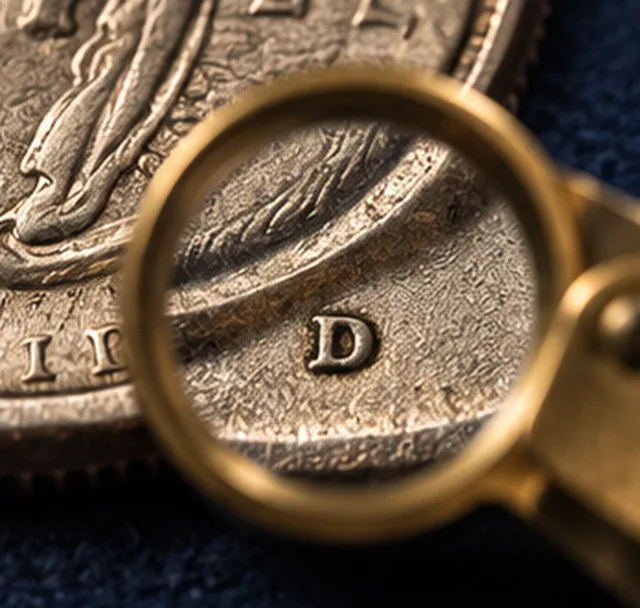
A single small letter decides whether a 1909 Lincoln cent is worth a few dollars or close to a thousand. That letter is the mint mark, and it tells you which branch of the U.S. Mint struck the coin. Nine facilities have struck coins under the U.S. Mint, each with its own letter, though Philadelphia, the original mint, left its coins blank for most of its history. That is why an empty space where a mark would go also tells you something.
Every U.S. mint and its letter
Branch mints first opened in 1838, when Charlotte, Dahlonega and New Orleans began striking coins, and their output carried a letter while Philadelphia's did not. The table lists the coining years the U.S. Mint gives for each facility.
| Mark | Mint | Years | What it struck |
|---|---|---|---|
| None, later P | Philadelphia, PA | 1793 to today (P from 1942 on some coins) | Every denomination |
| C | Charlotte, NC | 1838 to 1861 | Gold only |
| D | Dahlonega, GA | 1838 to 1861 | Gold only |
| O | New Orleans, LA | 1838 to 1861, 1879 to 1909 | Gold and silver |
| S | San Francisco, CA | 1854 to today | Circulating coins to 1955, then again in some years; proofs since 1968 |
| CC | Carson City, NV | 1870 to 1893 | Gold and silver |
| D | Denver, CO | 1906 to today | Circulating coins |
| W | West Point, NY | Coins from 1974; W mark from 1984 | Bullion, proofs, commemoratives, some quarters |
The ninth mint, Manila, struck Philippine coins with an M from 1920 and does not appear on regular U.S. coinage. The two D mints never overlap: Dahlonega closed in 1861 and Denver did not strike coins until February 1906, so a D on a gold coin dated before the Civil War is Georgia and a D on anything from 1906 on is Colorado. Denver had been authorized as a branch mint in 1862 but spent four decades as an assay office first.
All three Southern branches stopped coining when the Civil War began. Only New Orleans came back, from 1879 until 1909. Carson City was built to turn silver from Nevada's Comstock Lode into coin and closed for good in 1893, which is why CC coins exist in such small numbers.
Where the mark is on each series
Mint marks sat on the reverse (back) of most coins until 1965. When they came back in 1968 they moved to the obverse (front). The Lincoln cent is the exception that never moved: its mark has always been on the front, under the date. Each series has a hub page on this site, such as Lincoln cents and Washington quarters, with the location by year. Use a 10x loupe, because many of these letters are less than a millimeter tall.
| Series | Years | Where to look |
|---|---|---|
| Lincoln cent | 1909 to today | Front, below the date |
| Buffalo nickel | 1913 to 1938 | Back, below FIVE CENTS under the bison |
| Jefferson nickel | 1938 to 1964 | Back, right of Monticello (wartime silver: large letter above the dome) |
| Jefferson nickel | 1968 on | Front, right of Jefferson's portrait, near the date |
| Mercury dime | 1916 to 1945 | Back, lower left, beside the base of the fasces |
| Roosevelt dime | 1946 to 1964 | Back, left of the torch's base |
| Roosevelt dime | 1968 on | Front, above the date |
| Washington quarter | 1932 to 1964 | Back, below the wreath under the eagle |
| Washington quarter | 1968 on | Front, right of Washington's ponytail |
| Walking Liberty half | 1916 to 1947 | Front below IN GOD WE TRUST (1916 and some 1917), then back, lower left |
| Franklin half | 1948 to 1963 | Back, above the Liberty Bell's beam |
| Kennedy half | 1964; 1968 on | 1964: back, near the eagle's claw and olive branch. 1968 on: front, above the date |
| Morgan dollar | 1878 to 1921 | Back, under the wreath, above the D and O of DOLLAR |
| Peace dollar | 1921 to 1935 | Back, lower left, under ONE near the wing tip |
In 1917 the acting Mint director ordered the Walking Liberty mark moved to the reverse because, on the front, it looked like a flaw in the die. That is why 1917-D and 1917-S halves come in two versions, and most of each were struck with the letter on the back.
1965 to 1967: the years with no mint marks
The Coinage Act of 1965 ended 90% silver in dimes and quarters and dropped the silver in half dollars to 40%. During the changeover the country had a serious coin shortage, and the Mint blamed part of it on collectors pulling new coins out of circulation by mint. Its answer was to remove mint marks from every circulating coin dated 1965, 1966 and 1967, so there was no Denver or San Francisco version to hoard. Denver and San Francisco kept striking coins in those years. You just can't tell them apart from Philadelphia pieces.
So a 1965 quarter or a 1966 dime with no letter is completely normal and is not an error. Marks returned in 1968 on the front of the coin, and proof coinage moved to San Francisco the same year, which is why proofs from 1968 on carry an S.
The P mark, and why most old Philadelphia coins have none
For its first century and a half the Philadelphia Mint was the parent facility and simply left its coins blank. The first P appeared in 1942 on wartime nickels made from an alloy of 35% silver, 56% copper and 9% manganese, because nickel was needed for the war. To make them easy to sort out and withdraw later, the Mint stamped an oversized mint letter over the dome of Monticello on the reverse. A 1942 nickel with a big P over the building is a silver war nickel; one with no letter is the regular copper-nickel alloy.
After 1945 the P vanished again. It came back on the Susan B. Anthony dollar in 1979, and a year later Philadelphia's letter spread to its nickels, dimes, quarters and halves. Cents stayed blank as a nod to tradition, so Philadelphia cents still carry no letter. The one exception is 2017, when cents carried a P for the Mint's 225th anniversary.
W for West Point and CC for Carson City
West Point opened in 1937 as a bullion depository for silver. It began striking Lincoln cents in 1974 and Washington quarters from 1977 to 1979, all without a mint mark, so those coins look exactly like Philadelphia ones. The first W coins were the 1984 Olympic $10 gold pieces, struck in September 1983. West Point became an official mint on March 31, 1988, and most W coins since have been bullion, proof or commemorative issues sold to collectors.
The first W on a circulating coin came in 2019, when the Mint struck 2 million of each of the five America the Beautiful quarter designs at West Point, 10 million in all. They were not sold in rolls; the Mint mixed them into ordinary bags at Philadelphia and Denver so they would turn up in change.
CC is the mark collectors chase hardest on Morgan dollars. Carson City struck far fewer coins than the other mints, so nearly every CC date carries a premium even in worn condition.
Why the same coin is worth more from one mint
A mint mark changes value for one reason: it separates a large mintage from a small one. Collectors who want one of every date and mint compete for the scarce combinations. The prices below are from this site's year pages, checked October 2026.
| Coin | Mintage | Worn value |
|---|---|---|
| 1909 VDB cent, no mark | 27,995,000 | $8 to $20 |
| 1909-S VDB cent | 484,000 | $800 to $1,400 |
| 1939 nickel, no mark | 120,615,000 | 15 to 50 cents |
| 1939-D nickel | 3,514,000 | $4 to $12 |
| 1889 Morgan dollar, no mark | 21,726,000 | About silver value plus a small premium |
| 1889-CC Morgan dollar | 350,000 | $1,000 to $2,000 |
See the full tables on the 1909 penny, 1939 nickel and 1889 silver dollar pages. The 1909-S VDB is the clearest case: the same design struck in San Francisco in about 1/58 the quantity of the Philadelphia coin, and it is the key date of the whole Lincoln series.
Mint marks also produce varieties. When a die was punched with one letter and then corrected with another, traces of both can show, as on the 1882-O dollar with an S under the O, which sells for about $85 to $175 worn. Repunched marks like the 1942-D nickel with a sideways D underneath bring premiums too.
Fakes built around the mint mark
Because the letter carries so much value, forgers add or remove it. A 1916 Mercury dime runs about $9 in Good, while a 1916-D starts around $1,650 in the same grade, according to PCGS figures CoinWeek cited in April 2026, so plain 1916 dimes get a D attached. Going the other way, a D can be tooled off an ordinary 1922-D cent to imitate the rare 1922 No D. CoinWeek describes fake 1889-S Morgans made from Philadelphia dollars by embossing an S from inside the coin through an access hole in the edge, which is then plugged. Genuine 1916-D marks have a boxy shape, and a doctored edge often shows broken or uneven reeding. Any coin where the mint mark makes a large difference should be authenticated by PCGS or NGC before you buy or sell. See fake and altered coins for the other warning signs.
Supplies mentioned in this guide
As an Amazon Associate I earn from qualifying purchases. These are paid links. Affiliate disclosure.
Questions
What does it mean if my coin has no mint mark?
Usually that it was struck in Philadelphia. It can also mean the coin is dated 1965, 1966 or 1967, when no circulating coins carried marks, or that it is a cent or quarter struck without a mark at West Point or San Francisco in the 1960s, 1970s or 1980s.
Is a D mint mark always Denver?
No. Dahlonega, Georgia used D on gold coins from 1838 to 1861. Denver's D begins in 1906, so the date settles it.
Why does my 1980 or later dime have a P but my penny does not?
Philadelphia added the P to nickels, dimes, quarters and half dollars in 1980 but kept the cent unmarked by tradition. Only 2017 cents carry a P.
Are W quarters valuable?
The 2019 W quarters were made in quantities of 2 million per design and released only into circulation, so they are scarcer than P and D quarters and collectors pay a premium for them, though they are far from rare.
Where is the mint mark on a silver war nickel?
On the back, as a large P, D or S above the dome of Monticello. Those coins, dated 1942 to 1945, contain 35% silver.
Sources
- Mint Marks (United States Mint)
- Mint mark (Wikipedia)
- Denver Mint facility history (United States Mint)
- The West Point Mint Before the W Mintmark (PCGS)
- U.S. Mint strikes West Point quarters for circulation (Coin World)
- P mintmarks added long after absence (Numismatic News)
- Mintmarks off, mintmarks on: Who keeps it straight? (Numismatic News)
- Jefferson nickel (Wikipedia)
- Walking Liberty half dollar (Wikipedia)
- Washington quarter (Wikipedia)
- Dime (United States coin) (Wikipedia)
- Kennedy half dollar (Wikipedia)
- Morgan dollar (Wikipedia)
- Franklin half dollar (Wikipedia)
- Counterfeit Mintmarks: How to Spot Altered Coins Before You Buy (CoinWeek, May 2026)
- Lincoln cent (Wikipedia)
Checked October 19, 2026. See our editorial policy for how we source facts.