 CoinYearValue
Valuable wheat pennies: the dates and varieties worth checking
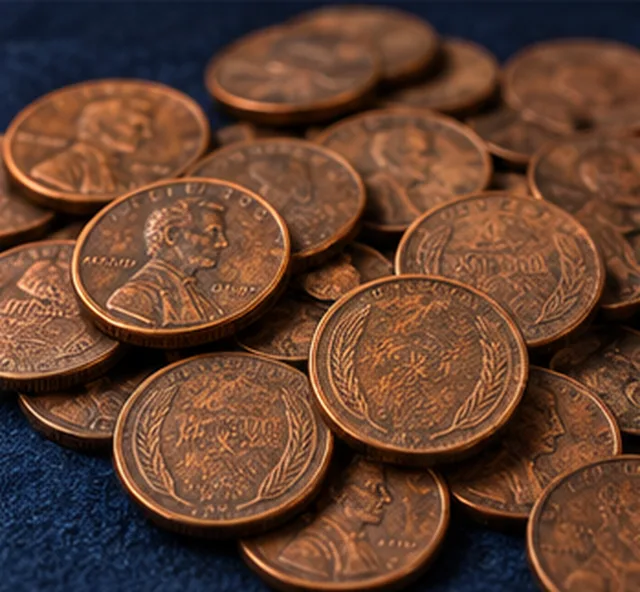
Out of roughly 50 years of wheat-back Lincoln cents, 4 dates stand far above the rest in worn condition: the 1909-S VDB, the 1914-D, the 1922 with no mint mark, and the 1931-S. Add a short list of doubled dies and two wartime metal errors, and you have nearly every wheat cent that sells for more than a few dollars. The other billions are copper, and a worn 1950s wheat cent carries about 4¢ of it.
Values below match our year-by-year Lincoln cent pages, checked October 7, 2026. For the three key dates that don't have their own page yet, we give the price-guide figures we checked in October 2026 and name the source.
The four key dates
These four are the coins that hold up a complete set. All four are scarce, and all four have been faked heavily, so the mint mark gets a hard look before any money changes hands.
| Coin | Made | Worn value |
|---|---|---|
| 1909-S VDB | 484,000 | $800–1,400 |
| 1914-D | 1,193,000 | about $173 in Good, $490 in Very Fine |
| 1931-S | 866,000 | about $76 in Good, $100 in Extremely Fine |
| 1922 No D | part of 7,160,000 Denver cents | thousands in the better worn grades |
| 1909-S (no VDB) | 1,825,000 | $90–175 |
The 1909-S VDB has the lowest mintage of any regular Lincoln cent. Brenner's initials on the reverse drew complaints, and the Mint had them taken off within days of the cent's release in August 1909, so San Francisco struck only 484,000 with VDB. See the full breakdown on the 1909 penny page, where the Philadelphia VDB (27,995,000 made, $8–20 worn) is also listed.
For the 1914-D, PCGS gives a survival estimate of about 1,000 coins across all grades and lists it among the most counterfeited 20th-century U.S. coins.
The 1931-S is the odd one: very low mintage, but dealers knew it would be scarce and put away rolls when it was new. That is why a worn one costs under $100 while a worn 1914-D costs more than twice that.
In 1922, Denver was the only mint making cents. Its dies wore out and the D faded or disappeared. The coin collectors pay up for is the No D with a strong reverse, from one particular die pair. A 1922 with a weak D, or one with a mushy reverse, sells for far less.
Better dates that sell for more than copper
Below the key dates sits a group of coins worth a few dollars worn and much more uncirculated. In the 1910s and 1920s the San Francisco and Denver coins are the ones to pull.
| Coin | Made | Worn | Uncirculated |
|---|---|---|---|
| 1910-S | 6,045,000 | $15–35 | $110–200 |
| 1917-D | 55,120,000 | $1–6 | $75–175 |
| 1918-S | 34,680,000 | $1–5 | $90–250 |
| 1919-D | 57,154,000 | $1–5 | $70–150 |
| 1920-S | 46,220,000 | $1–6 | $110–225 |
| 1939-D | 15,160,000 | 25–75¢ | $3–8 |
Other low-mintage branch-mint dates from this era include the 1911-S (4,026,000), 1912-S (4,431,000), 1914-S (4,137,000), 1924-D (2,520,000), 1926-S (4,550,000) and 1931-D (4,480,000). A worn 1931-D lists for about $4.45 in Good, so a low mintage does not always mean a big price.
Doubled dies, repunched mint marks and metal errors
These varieties need a 10x loupe. On a real doubled die the second image is part of the die itself, so every coin from it shows the same doubled letters. Smeared, flat doubling from a worn die looks similar to a beginner and adds nothing.
| Variety | Where to look | Typical value |
|---|---|---|
| 1958 doubled die obverse | LIBERTY, IN GOD WE TRUST | $300,000–1,100,000 (3 known) |
| 1943 bronze cent | copper color, not magnetic | $200,000–350,000 |
| 1944 steel cent | gray, sticks to a magnet | $25,000–40,000 |
| 1955 doubled die obverse | date and lettering, visible without a loupe | $1,500–3,000 |
| 1917 doubled die obverse | IN GOD WE TRUST, date | $150–1,000 |
| 1909-S, S over horizontal S | sideways S under the mint mark | $90–300 |
| 1936 doubled die obverse | LIBERTY, motto, date | $75–300 |
| 1943-D, D over D | second D beside the mint mark | $75–200 |
| 1944-D, D over S | parts of an S around the D | $60–250 |
| 1941 doubled die obverse | above LIBERTY, right of TRUST | $40–150 |
| 1946-S, S over D | D traces under the S | $15–100 |
| 1951-D, D over S | S traces under the D | $5–25 |
The 1955 doubled die came from a single obverse die on one night shift at Philadelphia. About 20,000 to 24,000 reached circulation. Far more common is the worn-die look-alike where only the last 5 of the date looks smeared; that one is worth little over a normal 1955 cent. More varieties from all years are on our rare pennies list.
For the wartime pair, start with a magnet: bronze ignores it and steel jumps to it. Most copper-looking 1943 cents turn out to be plated steel or a later date that has been altered. The 1943 and 1944 pages have the details.
What an ordinary wheat penny is worth
A worn wheat cent from the mid-1930s through 1958 is worth about 4¢, which is its copper. It still spends as one cent, and a Treasury regulation bars melting cents, so that 4¢ is a guide to metal content rather than money you can collect.
- Worn 1940s and 1950s cents: about 4¢ each. An uncirculated 1956 or 1957 brings 25¢–$1.
- Worn 1943 steel cents: 10–50¢ for a Philadelphia coin, a little more for D and S.
- Worn 1910s and 1920s Philadelphia cents: roughly 20¢–$2, depending on the year.
- Pre-1934 S and D coins and the 1939-D: worth pulling and checking against the tables above.
How to check a jar of wheat pennies
- Spread the coins on a towel under good light. Pull every gray steel cent first; those are 1943s.
- Run a magnet over any copper-colored 1943 and any gray 1944. A copper 1943 that sticks is plated steel.
- Sort by decade. Most of a typical jar will be 1940s and 1950s. Set aside everything dated 1909 to 1933 in its own pile.
- On the early pile, check the mint mark under the date. Look hardest at 1909-S, 1910-S, 1914-D, 1922 (no mark), 1924-D, 1926-S and 1931-S. For 1909 coins, turn them over and check the base of the reverse, below the wheat stalks, for the letters VDB.
- With a loupe, check the date and lettering on every 1917, 1936, 1941, 1955 and 1958.
- Look at mint marks on 1943-D, 1944-D, 1946-S and 1951-D for a second letter underneath.
- Put anything promising in a paper envelope or holder. Do not clean or polish it (here's why).
A pound of bronze cents is about 145 coins at 3.11 grams each, so a 10-pound jar holds close to 1,500. The decade sort is what keeps that manageable: only the early pile and a few variety dates ever go under the loupe.
Fakes made from common wheat cents
The key dates are rarely copied from scratch. Most fakes start as a genuine common cent with something added or removed.
- Added S on a 1909 VDB. A Philadelphia VDB already carries the initials, so a single glued or pushed-up letter makes an $8 coin pose as an $800 one. Specialists check the S against the few dies San Francisco actually used.
- Added D on a 1914 Philadelphia cent, and 1944-D cents with half the 4 scraped off to read 1914. That last one fails a simple test: 1944 cents have tiny VDB initials on Lincoln's shoulder, and 1914 cents do not.
- Tooled-off D on a 1922-D. Turn the coin over. The No D that collectors want pairs a tired front with a crisp back.
- Added S on a 1931 cent. Authenticators compare the letter's spot and angle with the five known 1931-S dies.
The fakes guide goes further into each check, and coin grading explained covers what grading a key date costs and returns.
Supplies mentioned in this guide
As an Amazon Associate I earn from qualifying purchases. These are paid links. Affiliate disclosure.
Questions
Which wheat penny is worth the most?
Among regular-issue coins, the 1909-S VDB is the key, at about $800 to $1,400 even when worn. The errors go far higher: a 1943 bronze cent is typically $200,000 to $350,000, and the 1958 doubled die, with only 3 known, is valued at $300,000 to $1,100,000.
Are all wheat pennies worth more than a cent?
Yes, but usually not by much. A worn wheat cent from the 1940s or 1950s is worth about 4 cents for its copper. Coins from 1909 to 1933, especially with S or D mint marks, are where real premiums start.
Is a 1922 penny with no mint mark valuable?
It can be. All 1922 cents were struck in Denver, so one with no D is either a genuine No D from worn dies or a 1922-D with the mint mark removed. The valuable version has a strong reverse and sells for thousands in better worn grades. Have it authenticated.
Should I get my 1914-D penny graded?
Yes. PCGS lists the 1914-D as one of the most counterfeited 20th-century U.S. coins and advises against buying one raw. A certified coin is worth more and much easier to sell.
How do I tell a real 1955 doubled die from a fake?
On a real one the doubling is wide enough to see without a loupe across the date and both inscriptions, and PCGS notes faint up-and-down polish marks beside the T of CENT on the back. A coin where just the final digit looks blurry came from a worn die and carries little premium.
Sources
- 1909 Lincoln Cent Date Guide (CopperCoins)
- 1914 Lincoln Cent Date Guide (CopperCoins)
- 1931 Lincoln Cent Date Guide (CopperCoins)
- 1922 Lincoln Cent Date Guide (CopperCoins)
- 1914-D 1C RD, PCGS CoinFacts
- 1922 No D 1C Strong Reverse BN, PCGS CoinFacts
- 1955 1C Doubled Die Obverse BN, PCGS CoinFacts
- 1955 doubled-die cent (Wikipedia)
- 1909-S VDB Lincoln Cent (Wikipedia)
- 1943 steel cent (Wikipedia)
Checked October 19, 2026. See our editorial policy for how we source facts.