 CoinYearValue
Coin roll hunting: searching bank rolls for silver, copper and errors
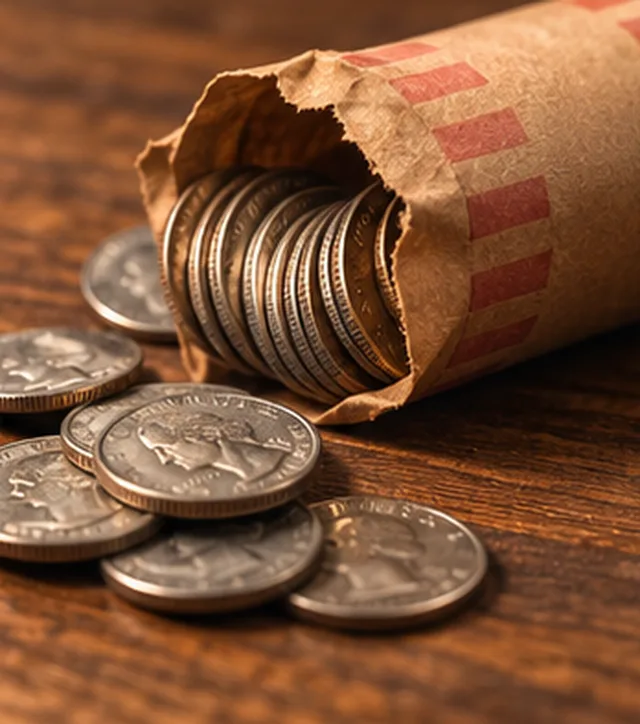
Coin roll hunting costs nothing but time. You buy rolls of coins from a bank at face value, look through them, keep anything worth more than face, and take the rest back. The catch is that most rolls hold nothing at all, and hunters who search several full boxes and come up empty are normal, not unlucky.
Getting rolls from a bank
Ask a teller for rolls by denomination and say how many you want. A branch keeps a limited supply on hand, so for more than a few rolls, call ahead and ask them to order it. Having an account at that bank makes the request simpler.
| Coin | Coins per roll | Cost of one roll |
|---|---|---|
| Cent | 50 | $0.50 |
| Nickel | 40 | $2 |
| Dime | 50 | $5 |
| Quarter | 40 | $10 |
| Half dollar | 20 | $10 |
| Small dollar | 25 | $25 |
Half dollar and dollar rolls are getting harder to find. If your branch can't get halves, ask whether a larger branch nearby can.
Cents may get scarce at banks over the next few years. The Treasury placed its last order of cent blanks in May 2025, and the final ceremonial strike of the circulating cent took place on November 12, 2025.
What to look for in each denomination
Cents
Copper wheat cents (1909–1958) are the classic find; our wheat penny guide lists the dates that matter. Gray 1943 steel cents turn up too. Some hunters also keep every 1959–1982 copper Memorial cent for its metal, which is about 4¢ per coin. A typical cent roll today runs around 20% copper and 80% zinc cents. The year 1982 had both kinds, and a scale sorts them: copper cents come in near 3.1 grams, zinc ones near 2.5 (see the 1982 penny page).
Nickels
Look for the 1942–1945 war nickels with a large mint mark above Monticello's dome. They are 35% silver, about 0.05626 troy oz each, and the 1943 nickel page shows the current silver value. Hunters keep Buffalo nickels (1913–1938) as well. The 2009 nickels had a low mintage and are also worth a second look.
Dimes and quarters
Anything dated 1964 or earlier is 90% silver. Silver dimes and quarters are the hardest to find because most were pulled from circulation decades ago. Check the edge: clad coins from 1965 on have a pure copper core that shows as a copper stripe, while a silver coin's edge is solid silver-gray. A 1964 quarter weighs 6.25 grams (see the 1964 quarter page).
Half dollars
Halves are the one denomination with two kinds of silver coin to find. The 1964 Kennedy half is 90% silver and weighs 12.5 grams. The 1965–1970 Kennedys are 40% silver and weigh 11.5 grams, only slightly more than the 11.34-gram clad halves that followed. Our 1964 and 1967 half dollar pages carry live silver values.
Silver and copper odds
No bank tracks this, so any precise rate you see online is one hunter's own tally. The broad pattern is clearer. Dimes and quarters return the least silver, because most of it left circulation long ago. Half dollars get most of the attention, since they add a second group of silver coins (1965–1970) on top of the 1964 and earlier ones. Every hunter who keeps the silver they find also shrinks what's left for the next person, so the odds keep slipping.
Copper cents are the opposite: plentiful but worth little each. Pulling every pre-1982 cent from a box gives you a steady stack of copper, but the profit is small because each coin is still mostly face value.
Tools worth having
- A pocket scale accurate to a hundredth of a gram, for 1982 cents and anything whose metal you doubt.
- A 10x loupe for dates, mint marks and doubling.
- A small magnet. Steel cents stick, and so do plated base-metal fakes.
- Empty paper rolls or plastic tubes in each size, so you can reroll on the spot.
- A tray with raised edges, which keeps 50 dimes from rolling under the couch.
None of it costs much, and the scale earns its place the first time you sort a box of cents.
A sorting routine that keeps it fast
- Open one roll at a time onto a tray or towel, so nothing mixes with coins you have already checked.
- For dimes, quarters and halves, stack the coins and look at the edges first. Silver edges stand out against the copper stripe of clad coins.
- Flip through and read every date. Pull anything older than you expect: pre-1965 silver, 1965–1970 halves, war nickels, wheat cents.
- For cents, sort into three piles: wheat cents, 1959–1982 Memorials, and post-1982 zinc. Weigh any 1982 cents on a scale reading to 0.01 gram.
- Check the keepers with a 10x loupe for doubled dies and repunched mint marks before they go into a holder.
- Reroll everything else right away and mark those rolls as searched so you don't open them again.
Keep the coins you pull in labeled envelopes by date and denomination. Don't clean anything; see why cleaning lowers value.
What it costs and how to return the rejects
The coins themselves cost face value, and you get that back when you return them. The real costs are your time, gas, and any coin you replace with face value from your pocket.
To return searched coins, bring the rerolled coins back to the bank to deposit or exchange for bills. Ask your bank how it wants them returned, since rules for loose coin and customer-wrapped rolls vary by branch. Return coins to a different branch than the one that sold them, or tellers may hand you your own searched rolls next time.
Grocery store coin kiosks are a poor way to cash out rejects. Coinstar charges a fee when you take cash; its own site advertises eGift card options with fees starting at 0%. Check the current rate at the machine before you use one.
What hunters really find
Expect empty boxes. Searching several boxes in a row without a single keeper is common, and the people who stick with the hobby treat a silver half or a wheat cent as a good day rather than a baseline.
Beyond silver and copper, hunters keep low-mintage modern dates such as the 1970 and 1987 halves, 2002–2020 halves, 2009 nickels and dimes, 2019 and 2020 West Point W quarters, and complete sets of state and America the Beautiful quarters. The 2026 Semiquincentennial designs are worth setting aside too. Mint errors such as off-center strikes and wrong-planchet coins show up occasionally; our error coin guide explains which ones carry a premium.
Supplies mentioned in this guide
As an Amazon Associate I earn from qualifying purchases. These are paid links. Affiliate disclosure.
Questions
Is coin roll hunting legal?
Yes. You are buying coins at face value from a bank and returning the ones you don't keep. What is not allowed is melting cents and nickels, so copper cents you keep are held, not melted.
Which coin rolls are best for finding silver?
Half dollars are the usual pick, since both the 1964 halves (90% silver) and the 1965 to 1970 halves (40% silver) count. Silver dimes and quarters are the scarcest finds in rolls.
Do banks charge for coin rolls?
The rolls themselves cost face value. Ask your branch whether it needs notice or an account for larger orders.
How can I tell a silver quarter in a roll quickly?
Look at the edge. A 1964 or earlier quarter has a solid silver edge with no copper stripe. A scale confirms it: a silver quarter weighs 6.25 grams.
What do I do with copper pennies I find?
Keep them stored dry in tubes or bags. A worn copper cent is worth about 4 cents for its metal, but melting them is not allowed, so collectors hold them or sell them in bulk to other collectors.
Sources
Checked October 19, 2026. See our editorial policy for how we source facts.