 CoinYearValue
Error coins explained: what is real, what is damage, and what it sells for
Most coins sold online as errors are nothing of the kind. A cent that looks doubled was usually struck by a bouncing die, and a penny with a bite out of it was usually cut or ground after it left the Mint. The test that separates the two is simple to state: a genuine error has to be explainable by something that happens while blanks are punched, dies are made, or coins are struck. If the only explanation is a hammer, a vise, a clothes dryer or acid, the coin is damaged and worth face value.
Typical values quoted below for specific coins come from this site's year pages; sale prices are individual auction results.
Errors versus varieties
Collectors split mistakes into two groups. A variety comes from the die itself, so every coin struck by that die shows the same feature. Doubled dies and repunched mint marks are varieties. An error is a one-off mishap during striking or blank making, such as an off-center strike, and no two are exactly alike.
The difference matters when you research a coin. A variety can be matched against reference photos of the known die, down to small marks and the exact direction of the doubling. An error is judged on how dramatic it is and how clearly it shows the cause.
Doubled dies
A working die gets its design pressed in by a hub. If the hub or die shifted or rotated between impressions, the die ended up with two overlapping images. Every coin struck from it then carries the same doubling. The 1955 Lincoln cent is the best known: PCGS traces it to the hub turning slightly between the blows that made the working die, and estimates that about 40,000 were struck, of which roughly 24,000 reached circulation.
On a true doubled die the second image is raised and rounded, with the same height and detail as the main design. Letters often show a clear notch or separation between the two outlines. The doubling also follows a consistent direction across the whole side of the coin. PCGS describes the 1972 doubled die cent as spread to the southwest on the date, south on LIBERTY and east on IN GOD WE TRUST.
| Coin | Where to look | Typical value (our year pages) | Notable sale |
|---|---|---|---|
| 1955 doubled die | Date, LIBERTY, motto; visible without a loupe | $1,500 to $3,000 | $287,156 (MS65+ Red) |
| 1969-S doubled die | Date, LIBERTY, motto, with an S mint mark | $15,000 to $40,000 | $126,500 (MS64 Red, 2008, the PCGS-listed record) |
| 1972 doubled die | All four digits of the date, LIBERTY, motto | $200 to $400 | $14,400 (MS67+ Red, 2019, the PCGS-listed record) |
PCGS lists more than 10 different doubled dies for 1972, and only one of them is the major variety worth hundreds. The 1969-S is so rare that PCGS estimates fewer than 100 were made, and the Secret Service ordered some genuine pieces destroyed while chasing a counterfeiting ring that sold fake ones.
Machine doubling, the common look-alike
Machine doubling (also called strike doubling) happens during the strike. A loose die bounces or shifts as it lifts off the coin and pushes the fresh design sideways. The result looks flat and shelf-like, as if the edge of each letter was smeared or sliced into a step. It adds little or nothing to the value.
Three checks separate it from a doubled die:
- Shape. Machine doubling is flat and lower than the main design. Hub doubling is rounded and full height.
- Spread. Machine doubling usually appears only on one side of letters and numbers, often just at the edges facing one direction.
- The mint mark. Mint marks on 1969-S and 1970-S cents were punched into each working die separately from the hub. A doubled S on those dates points away from a genuine doubled die and toward machine doubling or a separate repunching.
Worn dies cause a third kind of fuzzy doubling. Our 1955 page describes the so-called poor man's doubled die, a worn-die cent that shows smeared doubling mainly on the last 5 of the date and is worth little more than a normal coin.
Off-center strikes and broadstrikes
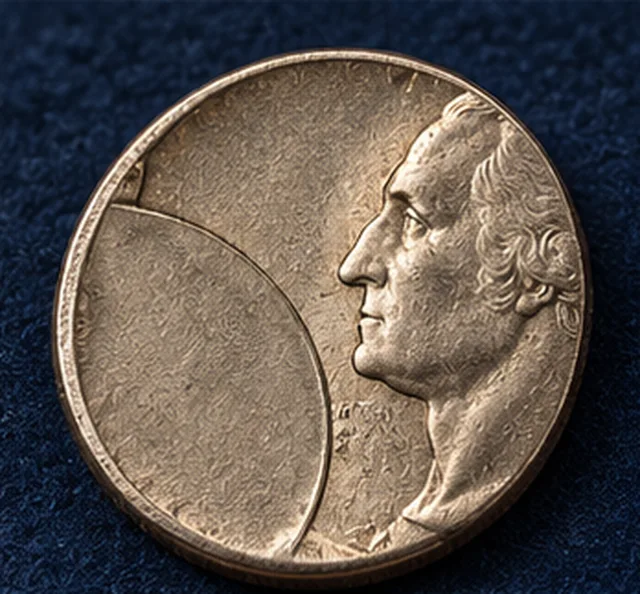
An off-center coin was struck once while the blank sat partly outside the dies. Part of the design is missing and a crescent of blank metal shows on one side. Value depends on how far off center the strike is, and coins that still show the full date sell for more than ones with the date partly or fully gone.
A broadstrike happens when the collar, the ring that holds the blank and forms the edge, is not in place. The metal spreads out beyond normal size. The design is centered and complete, but the coin is wider and thinner than usual. U.S. coins struck this way have plain edges, so a broadstruck dime or quarter has no reeding.
To check an off-center coin, look at the blank area. It should be smooth and have a raised rim only where the design is. A coin that was hammered or squeezed in a vise shows tool marks, distorted letters, and a design that is stretched rather than cut off cleanly.
Clipped planchets
Blanks are punched from long strips of metal. When the strip misfeeds, the punch overlaps a hole already cut or runs off the end of the strip, and the blank comes out with a piece missing. A curved clip comes from overlapping an earlier hole, a straight clip from the edge of the strip, and a ragged clip from the strip's end.
The way to tell a real clip from a coin someone snipped is the Blakesley effect. On a genuine curved clip, the rim directly opposite the clip is often weak or distorted, with some design detail lost there. A cut coin keeps a full rim all the way around up to the cut, and the cut edge shows tool marks or a bend in the metal.
Wrong planchet and wrong metal errors
A wrong planchet coin was struck on a blank meant for another denomination or another year's alloy. The classic modern example is a Lincoln cent struck on a dime blank. CoinWeek reports that these usually sell for about $1,000 to $2,000; a 1986-D cent on a clad dime blank graded PCGS MS63 brought $1,920 at Heritage in 2021. The coin has the size and silver-gray color of a dime with part of Lincoln's design running off the edge.
The famous 1943 copper cent is a wrong-metal error. Some bronze blanks left over from 1942 ended up among the steel ones. PCGS counts about 15 to 17 from Philadelphia, six from San Francisco and one from Denver, and the auction record is $372,000. Our 1943 penny page lists a typical value of $200,000 to $350,000. The 1965 quarters and dimes struck on leftover 90% silver blanks are a smaller version of the same mistake; see the 1965 quarter page.
Weight is the fastest check. A real 1943 copper cent weighs about 3.11 grams and does not stick to a magnet, while a plated steel cent weighs about 2.70 grams. A cent on a dime blank should weigh about 2.27 grams, the weight of a clad dime, not the 2.5 grams of a zinc cent.
| Blank | Weight |
|---|---|
| Bronze cent (the 1943 copper error) | 3.11 g |
| Steel cent, 1943 | 2.70 g |
| Zinc cent, 1982 to date | 2.50 g |
| Clad dime | 2.268 g |
Die cracks, cuds and repunched mint marks
Dies crack from the pressure of striking. A crack leaves a thin, raised, wandering line on every coin struck afterward. Many Morgan dollars show small die cracks. Cracks interest some specialists, but most are common and add little. A raised line is the key: a scratch on the coin is cut into the surface, while a die crack stands up from it.
When a piece of the die near the rim breaks off and falls away, the coins struck afterward have a raised, rounded blob of unstruck metal at the edge. Collectors call that a cud. A crack along the rim where the broken piece stayed in place is called a retained break and is harder to tell from a plain crack.
Mint marks were once punched into each working die as a separate step. If the first blow was off, a second blow left two overlapping letters. These repunched mint marks, or RPMs, are varieties and are attributed by matching the exact position of both letters. Examples on this site include the 1942-D nickel with a D over a sideways D on the 1942 nickel page. Read our mint mark guide for where each letter sits.
Damage that gets sold as an error
Most distorted, discolored, flattened, cut, bubbled or plated cents were changed after they left the Mint. The common ones:
- Plating and color changes. Copper-plated zinc cents corrode and blister, and chemicals or heat turn coins silver, gold or rainbow colors. No mint process produces a silver-colored zinc cent.
- Vise and hammer marks. Squeezing a coin can raise the rim, thin the coin, or push metal into shapes that look like doubling or an extra mint mark.
- Dryer and tumbling wear. Coins left in laundry machines come out thinned with rounded rims.
- Altered dates and added mint marks. Many 1943 copper cents are plated steel cents or altered 1948 cents. See the fakes and altered coins guide.
A listing that says rare does not authenticate anything, and asking prices on eBay are not sales. Search sold listings or auction archives for the exact attribution, and send anything that might bring several hundred dollars to PCGS or NGC. The grading guide covers what that costs.
Supplies mentioned in this guide
As an Amazon Associate I earn from qualifying purchases. These are paid links. Affiliate disclosure.
Questions
Is my doubled penny worth anything?
Only if the doubling is raised and rounded and matches a listed doubled die. Flat, step-like doubling is machine doubling and is worth face value or a few cents.
How do I know if a clipped coin is real?
Check the rim opposite the clip. A genuine curved clip shows a weak or missing rim there, called the Blakesley effect. A coin cut after minting has a full rim and tool marks on the cut.
Does a die crack make a coin valuable?
Usually not by much. Most die cracks are common. Check sold listings for your exact coin before assuming a premium.
Should I get an error coin graded?
If it could be a major error or a listed variety worth several hundred dollars or more, yes. Authentication by PCGS or NGC is what buyers rely on for expensive errors, and it protects you from paying to sell a look-alike.
Sources
- Error coin (Wikipedia)
- Doubled die (Wikipedia)
- Cent FAQ, CopperCoins
- Is my penny valuable?, CopperCoins
- 1955 Doubled Die cent, PCGS CoinFacts
- 1972 Doubled Die cent, PCGS CoinFacts
- 1969-S Doubled Die cent, PCGS CoinFacts
- The 13 Rare Lincoln Cent Double Dies that Collectors Chase, CoinWeek
- 1943 Bronze cent, PCGS CoinFacts
- Why Lincoln Cents Struck on Roosevelt Dimes Remain So Popular, CoinWeek
- 1965 Silver Quarter Value, CoinWeek
Checked October 19, 2026. See our editorial policy for how we source facts.